Breaking into Data Engineering as a fresher can feel overwhelming.
You hear about Python, SQL, Apache Spark, Azure Data Factory, Databricks, Snowflake, AWS, ETL pipelines, data warehouses, and hundreds of other technologies.
The biggest challenge is not learning all these tools. It is understanding what to learn, in what order, how to gain practical experience, and how to confidently answer interview questions.
If you are a fresher, a final-year student, or someone switching careers into Data Engineering, this guide will help you build the right skills and prepare for real-world Data Engineer interviews in just six months.
This is not just another list of technologies. It is a practical, month-by-month roadmap covering:
- Essential programming and SQL skills.
- Python for Data Engineering.
- ETL and ELT concepts.
- Database and Data Warehouse fundamentals.
- Azure Data Factory and Databricks.
- Apache Spark and PySpark.
- Real-time and batch data processing.
- End-to-end Data Engineering projects.
- Resume preparation and interview strategies.
- Frequently asked Data Engineer interview questions.
Let’s start from the basics.
1. What Does a Data Engineer Actually Do?
Before starting your preparation, understand what a Data Engineer does in a real company.
A Data Engineer is responsible for designing, developing, maintaining, and optimizing data pipelines that collect data from different sources, transform it, and make it available for analytics, reporting, and machine learning.
For example, imagine an e-commerce company like Amazon.
Every day, customers:
- Place thousands of orders.
- Make payments.
- Search for products.
- Add products to their carts.
- Return purchased items.
All this information is generated from different systems.
A Data Engineer builds pipelines to collect this information, clean it, transform it, and store it in a centralized data platform.
The processed data is then used by Data Analysts, Business Intelligence Developers, and Data Scientists.
Typical responsibilities of a Data Engineer
- Building ETL and ELT pipelines.
- Writing complex SQL queries.
- Developing Python scripts for data processing.
- Working with relational and NoSQL databases.
- Building batch and streaming data pipelines.
- Implementing data quality checks.
- Working with cloud platforms.
- Optimizing Spark jobs and SQL queries.
- Managing data warehouses and data lakes.
- Monitoring pipeline failures and resolving production issues.
Interview Tip: Interviewers want to know whether you understand the complete data lifecycle, not just whether you know how to write code.
2. Skills Required to Become a Data Engineer in 2026
You do not need to learn every technology available in the market.
Focus on building strong fundamentals and then choose one cloud ecosystem.
Here is the recommended learning stack for beginners.
| Skill | What You Should Learn | Priority |
|---|---|---|
| SQL | Joins, CTEs, Window Functions, Optimization | Very High |
| Python | Core Python, Pandas, File Handling, APIs | Very High |
| Database | MySQL, PostgreSQL, SQL Server | Very High |
| ETL/ELT | Data Extraction, Transformation, Loading | Very High |
| Data Warehousing | Star Schema, Snowflake Schema, SCD | High |
| Azure | Azure Data Factory, ADLS Gen2 | High |
| Databricks | Workspace, Notebooks, Delta Lake | High |
| Apache Spark | Spark Architecture, PySpark | High |
| Git | GitHub, Branching, Version Control | Medium |
| Power BI | Basic Reporting and Visualization | Medium |
| Kafka | Streaming Fundamentals | Medium |
My Recommended Technology Stack
For beginners targeting Azure Data Engineer roles:
- Programming: Python
- Query Language: SQL
- Database: SQL Server
- Cloud: Microsoft Azure
- ETL Tool: Azure Data Factory (ADF)
- Storage: Azure Data Lake Storage Gen2
- Big Data: Apache Spark
- Processing: PySpark
- Data Platform: Azure Databricks
- Data Format: CSV, JSON, Parquet, Delta
- Version Control: Git and GitHub
Once you understand this stack, you can transition to AWS or Google Cloud much more easily.
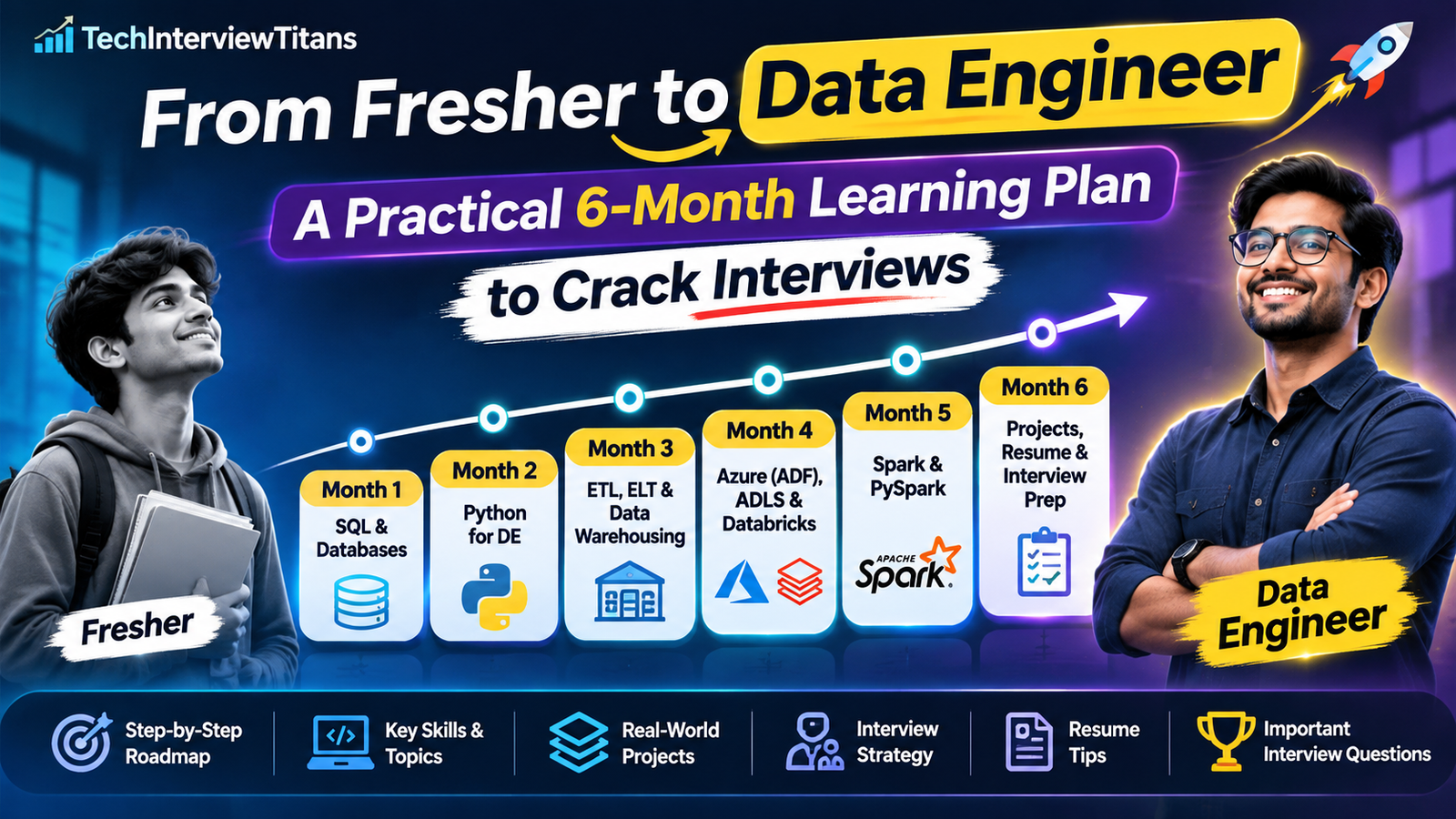
3. Complete 6-Month Data Engineer Learning Roadmap
Let’s divide your preparation into six months.
Each month has a clear learning objective, important topics, practical exercises, and expected outcomes.
Month 1: SQL and Database Fundamentals
Goal: Become confident in SQL and understand how databases work.
SQL is one of the most important skills for a Data Engineer.
Many companies start their technical interviews with SQL questions because they want to evaluate your problem-solving and data-handling abilities.
Topics to Learn
SQL Fundamentals
- What is SQL?
- DBMS vs RDBMS.
- Primary Key and Foreign Key.
- Constraints.
- CREATE, ALTER, DROP.
- INSERT, UPDATE, DELETE.
- SELECT and WHERE.
- ORDER BY and GROUP BY.
- HAVING clause.
- DISTINCT and LIMIT.
SQL Intermediate
11. INNER JOIN.
12. LEFT JOIN.
13. RIGHT JOIN.
14. FULL OUTER JOIN.
15. SELF JOIN.
16. CROSS JOIN.
17. Subqueries.
18. Correlated Subqueries.
19. Common Table Expressions (CTEs).
20. CASE WHEN statements.
Advanced SQL
21. ROW_NUMBER().
22. RANK() and DENSE_RANK().
23. LEAD() and LAG().
24. FIRST_VALUE() and LAST_VALUE().
25. PARTITION BY.
26. Running Total.
27. Moving Average.
28. Query Optimization.
29. Indexing.
30. Execution Plans.
Practical SQL Exercises
Create an employee database with the following tables:
- Employees
- Departments
- Salaries
- Projects
Practice questions such as:
- Find the second-highest salary.
- Find employees earning more than their department average.
- Find duplicate records.
- Find the top three highest-paid employees in each department.
- Find employees who joined in the last 30 days.
- Calculate department-wise salary totals.
- Find customers who placed more than five orders.
- Identify records that exist in one table but not another.
- Calculate month-over-month revenue.
- Find consecutive login dates for each user.
Month 1 Deliverable: Complete at least 100 SQL practice questions and upload your SQL scripts to GitHub.
Month 2: Python Programming for Data Engineering
Goal: Learn Python to automate data processing and build ETL scripts.
Python is widely used in Data Engineering for extracting, transforming, validating, and processing data.
You don’t need to become an expert software developer, but you should be comfortable writing production-oriented Python scripts.
Topics to Learn
Python Basics
- Variables and Data Types.
- Strings and Numbers.
- Lists, Tuples, Sets, and Dictionaries.
- Conditional Statements.
- For and While Loops.
- Functions.
- Lambda Functions.
- List Comprehensions.
Intermediate Python
9. Object-Oriented Programming.
10. Classes and Objects.
11. Inheritance.
12. Exception Handling.
13. File Handling.
14. Modules and Packages.
15. Decorators (basics).
16. Iterators and Generators.
17. Working with JSON.
18. Working with CSV files.
Python for Data Engineering
19. Pandas.
20. NumPy basics.
21. Reading CSV and Excel files.
22. Reading JSON files.
23. Connecting Python to SQL databases.
24. REST API integration.
25. Logging.
26. Error Handling.
27. Environment Variables.
28. Working with Large Files.
29. Data Validation.
30. Automating Data Pipelines.
Practical Python Projects
Project 1: CSV Data Processing
- Read a CSV file.
- Remove duplicate records.
- Handle missing values.
- Convert data types.
- Generate a cleaned CSV file.
Project 2: API Data Extraction
- Connect to a public REST API.
- Extract JSON data.
- Parse the response.
- Transform the data.
- Store the output in a database.
Project 3: Python to SQL Pipeline
- Extract employee data from CSV.
- Clean the records using Pandas.
- Connect to SQL Server.
- Load the transformed data into a SQL table.
- Implement error handling and logging.
Month 2 Deliverable: Build at least two Python-based ETL projects and publish the code on GitHub.
Month 3: ETL, ELT, Data Warehousing and Cloud Fundamentals
Goal: Understand how enterprise data pipelines work.
This month is extremely important because Data Engineer interviews frequently include questions about ETL architecture, data warehouses, data lakes, and incremental data loading.
ETL and ELT Concepts
Learn the difference between ETL and ELT.
ETL: Extract, Transform, Load
- Extract data from different sources.
- Transform the data.
- Load the processed data into the target system.
ELT: Extract, Load, Transform
- Extract data.
- Load raw data into the destination.
- Transform data inside the target platform.
Important ETL Topics
- ETL vs ELT.
- Batch Processing.
- Real-Time Processing.
- Full Load.
- Incremental Load.
- Change Data Capture (CDC).
- Watermarking.
- Data Validation.
- Data Deduplication.
- Schema Evolution.
- Error Handling.
- Pipeline Monitoring.
- Data Lineage.
- Retry Mechanisms.
- Idempotency.
Data Warehousing Topics
- What is a Data Warehouse?
- Data Lake vs Data Warehouse.
- Data Lakehouse.
- OLTP vs OLAP.
- Fact Tables.
- Dimension Tables.
- Star Schema.
- Snowflake Schema.
- Slowly Changing Dimensions (SCD).
- SCD Type 1.
- SCD Type 2.
- Surrogate Keys.
- Natural Keys.
- Partitioning.
- Data Modeling.
Cloud Fundamentals
Understand these concepts before working with cloud tools:
- Cloud Computing.
- IaaS, PaaS, SaaS.
- Storage Accounts.
- Object Storage.
- Data Lakes.
- Compute Resources.
- Networking Basics.
- Identity and Access Management.
- Cloud Security.
- Monitoring and Logging.
Month 3 Deliverable: Design an ETL pipeline architecture and explain how data moves from source systems to a data warehouse.
Month 4: Azure Data Engineering – ADF, ADLS Gen2 and Databricks
Goal: Learn how to build cloud-based data pipelines.
Now it’s time to work with actual cloud technologies.
For beginners targeting Azure Data Engineer positions, focus on three major services:
- Azure Data Factory.
- Azure Data Lake Storage Gen2.
- Azure Databricks.
Part 1: Azure Data Factory (ADF)
ADF is a cloud-based data integration service used to build and orchestrate data pipelines.
Important ADF Topics
- What is Azure Data Factory?
- ADF Architecture.
- Pipelines.
- Activities.
- Datasets.
- Linked Services.
- Integration Runtime.
- Self-hosted Integration Runtime.
- Azure Integration Runtime.
- Copy Activity.
- Lookup Activity.
- ForEach Activity.
- Get Metadata Activity.
- If Condition Activity.
- Until Activity.
- Execute Pipeline Activity.
- Parameters and Variables.
- Tumbling Window Triggers.
- Schedule Triggers.
- Event Triggers.
- Incremental Loading.
- Watermark Tables.
- Error Handling.
- Pipeline Monitoring.
- REST API Integration.
Important ADF Interview Scenario
How would you copy data from SQL Server to Azure Data Lake Storage Gen2 every day?
Expected approach:
- Create a Linked Service for SQL Server.
- Create another Linked Service for ADLS Gen2.
- Configure source and destination datasets.
- Create a Copy Activity.
- Configure the source query.
- Set the destination folder and file format.
- Configure scheduling through a trigger.
- Implement logging and error handling.
- Monitor pipeline execution.
Part 2: Azure Data Lake Storage Gen2
Learn:
- Storage Accounts.
- Containers.
- Blob Storage.
- Hierarchical Namespace.
- Access Control Lists (ACLs).
- RBAC.
- Managed Identity.
- Storage Tiers.
- File Formats.
- Folder Partitioning.
- Security and Access Management.
Part 3: Azure Databricks
Databricks is an important platform for large-scale data processing.
Important Topics
- What is Databricks?
- Databricks Architecture.
- Workspace.
- Clusters and Compute.
- Notebooks.
- Jobs.
- Databricks Runtime.
- Apache Spark.
- PySpark.
- DataFrames.
- Transformations and Actions.
- Lazy Evaluation.
- Narrow vs Wide Transformations.
- Shuffle Operations.
- Broadcast Joins.
- Caching and Persistence.
- Delta Lake.
- Delta Transaction Log.
- Time Travel.
- MERGE, UPDATE and DELETE.
- OPTIMIZE.
- VACUUM.
- Unity Catalog.
- Medallion Architecture.
- Schema Enforcement and Evolution.
Practical Project
Build an end-to-end Azure Data Engineering pipeline.
- Extract data from a SQL database.
- Use Azure Data Factory to orchestrate ingestion.
- Store raw data in ADLS Gen2.
- Process data using Azure Databricks and PySpark.
- Implement Bronze, Silver, and Gold layers.
- Store curated data in Delta Lake.
- Add data quality checks.
- Monitor pipeline execution.
Month 4 Deliverable: Complete one Azure Data Engineering project and understand every component of its architecture.
Month 5: Apache Spark, PySpark and Advanced Data Engineering
Goal: Become comfortable with distributed data processing and real-world scenarios.
Companies working with large datasets expect Data Engineers to understand Spark fundamentals.
Apache Spark Architecture
Learn these concepts:
- What is Apache Spark?
- Spark Architecture.
- Driver Program.
- Executors.
- Cluster Manager.
- SparkSession.
- SparkContext.
- Jobs, Stages and Tasks.
- DAG Scheduler.
- Catalyst Optimizer.
- Tungsten Execution Engine.
- Lazy Evaluation.
- Data Shuffling.
- Partitioning.
- Data Skewness.
PySpark Topics
- Creating DataFrames.
- Reading CSV, JSON and Parquet.
- Writing DataFrames.
- Select and Filter.
- GroupBy and Aggregations.
- Joins.
- Window Functions.
- User Defined Functions.
- Handling Null Values.
- Removing Duplicates.
- Repartition vs Coalesce.
- Cache vs Persist.
- Broadcast Joins.
- Performance Optimization.
- Handling Skewed Data.
Advanced Data Engineering Concepts
- Batch vs Streaming.
- Apache Kafka Fundamentals.
- Structured Streaming.
- Checkpointing.
- Watermarking.
- Exactly-once and At-least-once processing.
- Data Quality Frameworks.
- Pipeline Orchestration.
- CI/CD Fundamentals.
- Git Integration.
- Production Monitoring.
Month 5 Deliverable: Build a PySpark project that processes a large dataset and demonstrates joins, aggregations, partitioning, and performance optimization.
Month 6: Real-World Projects, Resume and Interview Preparation
Goal: Convert your technical knowledge into interview-ready skills.
This is where you should stop collecting tutorials and start preparing like someone who is ready to work on real projects.
Step 1: Build Three Strong Projects
Instead of building ten small projects, focus on three end-to-end projects.
Project 1: E-Commerce ETL Pipeline
Technologies:
- Python
- SQL
- Azure Data Factory
- ADLS Gen2
- Azure Databricks
- PySpark
Project workflow:
- Extract customer, product, and order data.
- Ingest data into the Bronze layer.
- Remove duplicates and invalid records.
- Apply business transformations.
- Implement incremental loading.
- Store cleaned data in the Silver layer.
- Create business aggregations in the Gold layer.
- Implement monitoring and logging.
Project 2: Incremental Data Loading Pipeline
Technologies:
- SQL Server
- Python
- Azure Data Factory
- ADLS Gen2
Implement:
- Watermark-based loading.
- Full and incremental loads.
- Handling updated records.
- Duplicate prevention.
- Failure recovery.
- Logging and monitoring.
Project 3: Real-Time Data Processing
Technologies:
- Apache Kafka.
- PySpark Structured Streaming.
- Databricks.
- Delta Lake.
Implement:
- Event ingestion.
- Stream processing.
- Data validation.
- Checkpointing.
- Window aggregations.
- Streaming output to a Delta table.
Step 2: Prepare Your Resume
Your resume should demonstrate what you can build, not just list technologies.
Include these sections:
- Professional Summary.
- Technical Skills.
- Data Engineering Projects.
- Internship or Work Experience (if applicable).
- Certifications.
- Education.
- GitHub Portfolio.
Example Resume Project Description:
E-Commerce Data Engineering Pipeline | Azure Data Factory | Databricks | PySpark
- Developed an end-to-end ETL pipeline to ingest e-commerce data from multiple source systems.
- Implemented incremental data loading using watermark-based processing.
- Processed and transformed datasets using PySpark.
- Designed Bronze, Silver, and Gold layers using the Medallion Architecture.
- Implemented data validation, deduplication, and error-handling mechanisms.
- Optimized Spark transformations using partitioning and broadcast joins.
Only include tools, features, and achievements you have genuinely implemented and can explain.
Step 3: Prepare for Mock Interviews
Practice answering questions aloud.
Prepare to explain:
- Your project architecture.
- Why you selected a particular technology.
- How your pipeline handles failures.
- How you handle duplicate records.
- How you implement incremental loading.
- How you optimize slow-running Spark jobs.
- How you maintain data quality.
- How you monitor production pipelines.
Month 6 Deliverable: Three presentable projects, a strong resume, an active GitHub portfolio, and at least 10 mock interviews.
4. Top 50 Important Data Engineer Interview Topics
After completing your six-month roadmap, revise these topics before attending interviews.
| Category | Important Interview Topics |
|---|---|
| SQL | Joins, CTEs, Window Functions, Subqueries |
| SQL | Indexing, Execution Plans, Query Optimization |
| Python | Lists, Dictionaries, Functions, OOP |
| Python | Pandas, APIs, Exception Handling |
| Database | Normalization, Keys, Constraints |
| Database | Transactions, ACID Properties |
| ETL | ETL vs ELT, Full Load, Incremental Load |
| ETL | CDC, Watermarking, Idempotency |
| Data Warehouse | Fact, Dimension, Star Schema |
| Data Warehouse | SCD Type 1 and Type 2 |
| Azure | ADF Architecture, Activities, Triggers |
| Azure | Integration Runtime, Parameters, Variables |
| Azure | ADLS Gen2, RBAC, ACL |
| Databricks | Architecture, Clusters, Notebooks |
| Databricks | Delta Lake, Time Travel, Unity Catalog |
| Spark | Driver, Executor, DAG, Stages, Tasks |
| PySpark | DataFrames, Joins, Aggregations |
| PySpark | Repartition, Coalesce, Caching |
| PySpark | Broadcast Join, Data Skew |
| Streaming | Kafka, Checkpointing, Watermarking |
| Architecture | Medallion Architecture, Data Lakehouse |
| Optimization | Partitioning, File Formats, Query Tuning |
| DevOps | Git, CI/CD, Deployment |
| Production | Monitoring, Logging, Failure Recovery |
5. Top 30 Data Engineer Interview Questions for Freshers
These are important questions to practice before applying for your first Data Engineer job.
SQL Interview Questions
1. What is the difference between WHERE and HAVING?
WHERE filters individual rows before grouping, while HAVING filters aggregated groups after GROUP BY.
2. What is the difference between RANK(), DENSE_RANK(), and ROW_NUMBER()?
- ROW_NUMBER(): Assigns a unique sequential number.
- RANK(): Assigns the same rank to ties and skips subsequent ranks.
- DENSE_RANK(): Assigns the same rank to ties without skipping ranks.
3. How do you find the second-highest salary?
Use a subquery, DENSE_RANK(), or MAX() with a suitable condition.
4. What is the difference between INNER JOIN and LEFT JOIN?
INNER JOIN returns matching records from both tables. LEFT JOIN returns all records from the left table and matching records from the right table.
5. What is a CTE in SQL?
A Common Table Expression is a temporary named result set that improves query readability and helps structure complex SQL queries.
6. What is the difference between DELETE, TRUNCATE, and DROP?
Understand how each command affects rows, table structure, and transaction behavior across different database systems.
Python Interview Questions
7. What is the difference between a list and a tuple?
Lists are mutable, while tuples are immutable.
8. What are Python decorators?
Decorators modify or extend the behavior of functions without directly changing their source code.
9. What is the difference between a generator and a normal function?
Generators use yield to produce values lazily, helping process large datasets without loading everything into memory.
10. How do you handle exceptions in Python?
Use try, except, else, and finally blocks.
11. How do you read a large CSV file efficiently?
Use chunk-based processing with Pandas or stream the file in manageable batches.
ETL and Data Warehousing Questions
12. What is the difference between ETL and ELT?
ETL transforms data before loading it into the destination. ELT loads data first and transforms it inside the destination platform.
13. What is incremental data loading?
It processes only new or changed records instead of reloading the entire dataset.
14. What is Change Data Capture (CDC)?
CDC identifies and captures data changes such as inserts, updates, and deletes.
15. What is a watermark column?
It stores a value, usually a timestamp or increasing ID, used to identify records processed during previous pipeline runs.
16. Explain SCD Type 1 and Type 2.
Type 1 overwrites old values. Type 2 preserves historical changes by creating new records with effective dates or current-record indicators.
17. What is the difference between a Data Lake and a Data Warehouse?
A Data Lake stores data in different formats, including raw data. A Data Warehouse stores structured and organized data optimized for analytics.
Azure Data Factory Questions
18. What is Azure Data Factory?
It is a cloud-based data integration and orchestration service.
19. What is the difference between a pipeline and an activity?
A pipeline groups and orchestrates activities. An activity performs a specific operation.
20. What is Integration Runtime?
It provides the compute infrastructure used by ADF for data movement, activity dispatch, and supported data transformation scenarios.
21. What is the difference between Parameters and Variables?
Parameters provide input values to pipelines and activities, while variables store values that can be updated during pipeline execution.
22. How do you implement incremental loading in ADF?
Use a watermark value, retrieve the last processed value, query changed records, load them into the destination, and update the watermark after a successful load.
Databricks and PySpark Questions
23. What is Apache Spark?
Apache Spark is a distributed processing engine designed for large-scale data processing.
24. What is the difference between transformations and actions?
Transformations define operations on data, while actions trigger execution and return results or write data.
25. What is lazy evaluation in Spark?
Spark delays executing transformations until an action triggers computation.
26. What is the difference between repartition() and coalesce()?
Repartition generally performs a shuffle to redistribute data. Coalesce can reduce partitions with less data movement when used appropriately.
27. What is Delta Lake?
Delta Lake is a storage layer that adds transactional reliability and features such as schema enforcement, time travel, and ACID transactions to data lakes.
28. What is the difference between a narrow and wide transformation?
Narrow transformations can process data without shuffling across partitions, while wide transformations require data redistribution.
29. What is a broadcast join?
It distributes a small dataset to worker nodes to reduce data shuffling during a join.
30. How do you handle data skew in Spark?
Use techniques such as salting, broadcast joins where appropriate, repartitioning, and analyzing skewed keys.
6. Real-World Scenario-Based Interview Questions
Freshers often prepare theoretical questions but struggle when interviewers ask practical scenarios.
Scenario-based questions test your ability to solve real production problems.
Here are 10 scenarios you should practice.
Scenario 1: Your daily pipeline failed halfway through execution. What will you do?
Expected answer:
- Check pipeline execution logs.
- Identify the failed activity.
- Check source and destination availability.
- Review error messages.
- Fix the root cause.
- Retry safely.
- Prevent duplicate data during reruns using idempotent processing.
Scenario 2: Your source database contains duplicate records. How will you handle them?
Expected answer:
- Identify the business key.
- Use SQL ROW_NUMBER() or PySpark dropDuplicates().
- Define which record should be retained.
- Apply deduplication before loading into the target.
- Add data quality checks.
Scenario 3: Your Spark job is running very slowly. How will you optimize it?
Expected answer:
- Analyze the Spark UI.
- Identify expensive shuffle operations.
- Check data skew.
- Review partition sizes.
- Use broadcast joins when appropriate.
- Avoid unnecessary actions.
- Optimize file sizes and caching.
Scenario 4: How will you process only newly inserted and updated records?
Expected answer:
Implement incremental loading using CDC or watermark-based extraction. Track the last successful processing position and handle inserts, updates, and deletes according to the source system’s change-tracking capabilities.
Scenario 5: What happens if the same pipeline runs twice?
Expected answer:
The pipeline should be designed to be idempotent. Reprocessing the same input should not create duplicate or inconsistent output.
Scenario 6: How do you handle schema changes in source files?
Expected answer:
Implement schema validation, schema evolution policies, logging, and controlled handling of unexpected columns or data types.
Scenario 7: How do you handle null values in a dataset?
Expected answer:
Identify missing values, understand business rules, and apply appropriate handling such as default values, filtering, or quarantine.
Scenario 8: How do you process files arriving late?
Expected answer:
Use event-based ingestion, scheduled reconciliation, or a controlled lookback window with deduplication and idempotent processing.
Scenario 9: How do you maintain data quality?
Expected answer:
Implement checks for completeness, uniqueness, validity, consistency, and referential integrity at appropriate pipeline stages.
Scenario 10: How do you secure sensitive data?
Expected answer:
Use least-privilege access, managed identities, RBAC, ACLs, encryption, secrets management, and appropriate masking policies.
7. Daily Study Schedule for Data Engineer Freshers
Consistency is more important than studying for 10 hours one day and doing nothing for the next three days.
Here is a practical daily schedule for someone who can dedicate approximately 4 hours per day.
| Duration | Activity |
|---|---|
| 60 Minutes | SQL Practice |
| 60 Minutes | Python / PySpark |
| 45 Minutes | Cloud Technology |
| 45 Minutes | Hands-on Project |
| 30 Minutes | Interview Questions |
Weekly Preparation Strategy
Monday to Friday
- Learn new concepts.
- Write code.
- Solve SQL problems.
- Practice Python.
- Work on projects.
Saturday
- Revise everything learned during the week.
- Solve scenario-based interview questions.
- Debug your project.
Sunday
- Conduct a mock interview.
- Update GitHub.
- Prepare interview notes.
- Revise weak topics.
8. How to Crack Your First Data Engineer Interview
Learning technologies alone will not guarantee a job.
You must learn how to present your knowledge during an interview.
Follow this strategy.
Step 1: Build Strong Fundamentals
Before applying, ensure you can confidently explain SQL, Python, ETL, databases, and basic data warehousing concepts.
Do not skip fundamentals just because cloud technologies look more attractive.
Step 2: Practice SQL Every Day
SQL is one of the most frequently tested skills in Data Engineering interviews.
Practice:
- Joins.
- Window Functions.
- CTEs.
- Aggregations.
- Subqueries.
- Date Functions.
- Duplicate Removal.
- Query Optimization.
Step 3: Learn One Cloud Platform Properly
Avoid learning Azure, AWS, and GCP simultaneously.
Choose one platform first.
For example, Azure:
- Azure Data Factory.
- Azure Data Lake Storage.
- Azure Databricks.
- Azure SQL Database.
- Microsoft Entra ID and managed identities.
Step 4: Explain Projects Like a Real Data Engineer
Prepare a clear explanation of every project.
Use this structure:
- What was the business problem?
- What were the data sources?
- What architecture did you design?
- Which technologies did you use?
- How did data move between systems?
- How did you handle duplicates?
- How did you implement incremental loading?
- How did you handle pipeline failures?
- How did you optimize performance?
- What was the final business outcome?
Never memorize a project explanation without understanding the actual implementation.
Step 5: Practice Mock Interviews
Conduct at least 10–15 mock interviews before your target interviews.
Practice:
- SQL coding rounds.
- Python coding rounds.
- ETL and data warehouse discussions.
- Cloud architecture questions.
- Scenario-based questions.
- Project explanation rounds.
- HR and behavioral questions.
Step 6: Apply Strategically
Do not wait until you know every technology.
Once you have strong fundamentals, at least two working projects, and a presentable resume, start applying.
Search for roles such as:
- Junior Data Engineer.
- Associate Data Engineer.
- Graduate Data Engineer.
- ETL Developer.
- Azure Data Engineer Trainee.
- Python Developer – Data Engineering.
- Data Integration Developer.
Job titles and experience requirements vary by company, so read the actual job description carefully.
9. Common Mistakes Freshers Make While Learning Data Engineering
Avoid these mistakes during your preparation.
1. Learning Too Many Technologies at Once
Don’t jump between AWS, Azure, GCP, Snowflake, Databricks, and Kafka without mastering the basics.
2. Ignoring SQL
You cannot build a strong Data Engineering foundation without SQL.
3. Watching Tutorials Without Writing Code
Watching a 10-hour course is not equivalent to having 10 hours of practical experience.
4. Building Only Small Projects
Try building complete pipelines with ingestion, transformation, storage, validation, and monitoring.
5. Memorizing Interview Answers
Interviewers often change the scenario. Focus on understanding concepts.
6. Ignoring GitHub
Your GitHub portfolio can demonstrate your ability to write code and build projects.
7. Waiting Until You Know Everything
No one knows every technology. Start applying when you meet the core requirements of entry-level roles.
8. Not Practicing Communication
A Data Engineer must explain technical decisions to developers, analysts, architects, and business teams.
10. Best Free Resources to Learn Data Engineering
Use official documentation and hands-on learning platforms.
| Platform | What to Learn |
|---|---|
| Microsoft Learn | Azure Data Factory, Azure Storage, Databricks |
| Python Documentation | Python Fundamentals |
| SQLBolt | SQL Basics and Practice |
| LeetCode | SQL and Python Coding |
| Databricks Documentation | Spark, PySpark, Delta Lake |
| Apache Spark | Spark Fundamentals |
| GitHub | Projects and Version Control |
| Kaggle | Datasets and Practical Projects |
My recommendation: Don’t collect 20 courses. Pick one learning resource for each technology and spend most of your time implementing what you learn.
11. How Long Does It Take to Become a Data Engineer?
The answer depends on your background, daily study time, programming experience, and practical implementation.
Here is a realistic preparation estimate:
| Background | Suggested Preparation |
|---|---|
| Complete Beginner | 6–9 Months |
| SQL Knowledge | 5–7 Months |
| Python Developer | 4–6 Months |
| Data Analyst | 4–6 Months |
| Experienced Developer | 3–6 Months |
A six-month plan can help you become interview-ready, but it does not guarantee employment. Your projects, coding ability, communication, and interview performance matter.
12. Final Checklist: Are You Ready for a Data Engineer Interview?
Before attending your first interview, check whether you can perform the following tasks.
- Write complex SQL queries using joins and window functions.
- Solve common SQL coding problems independently.
- Write Python scripts for data extraction and transformation.
- Read and process CSV, JSON, and Parquet files.
- Connect Python with a relational database.
- Explain ETL vs ELT.
- Explain incremental loading and CDC.
- Design a basic data warehouse.
- Explain Star Schema and SCD Type 2.
- Build an ADF pipeline.
- Understand ADLS Gen2 storage.
- Write PySpark DataFrame transformations.
- Explain Spark architecture.
- Understand Delta Lake.
- Explain Bronze, Silver, and Gold layers.
- Handle pipeline failures and duplicate records.
- Build at least two end-to-end projects.
- Explain your project architecture confidently.
- Maintain a GitHub portfolio.
- Complete mock interviews.
Conclusion: Your Data Engineering Journey Starts with the Basics
Becoming a Data Engineer as a fresher is not about learning 50 technologies or collecting hundreds of certificates.
It is about developing the ability to solve real data problems.
Start with SQL and Python. Understand databases, ETL, and data warehousing. Move to a cloud platform such as Azure. Learn Databricks and PySpark. Finally, build end-to-end projects and practice explaining your solutions.
Follow this six-month roadmap consistently, and you will have a much stronger foundation for entry-level Data Engineer interviews.
Remember:
You don’t need to know everything to get your first Data Engineering job.
You need to understand the fundamentals, demonstrate practical skills, and confidently explain what you have built.
Start small. Practice daily. Build real projects. Keep improving.
Your first Data Engineer opportunity could be closer than you think!
Explore More Data Engineering Interview Preparation Resources
If you want structured notes, practical examples, and interview-oriented preparation material, explore these resources:
- Top 100 Real Data Engineer Interview Questions & Answers
- Azure Data Factory (ADF) Mastery Guide 2026
- ETL & ELT Complete Guide 2026 – 86 Modules
Keep Learning. Keep Building. Keep Cracking Interviews!
Visit TechInterviewTitans.com for more Data Engineering notes, interview questions, and practical learning resources.