Salesforce Agentforce is changing how organizations build AI-powered service experiences by combining AI agents, automation, Salesforce Flow, and business data.
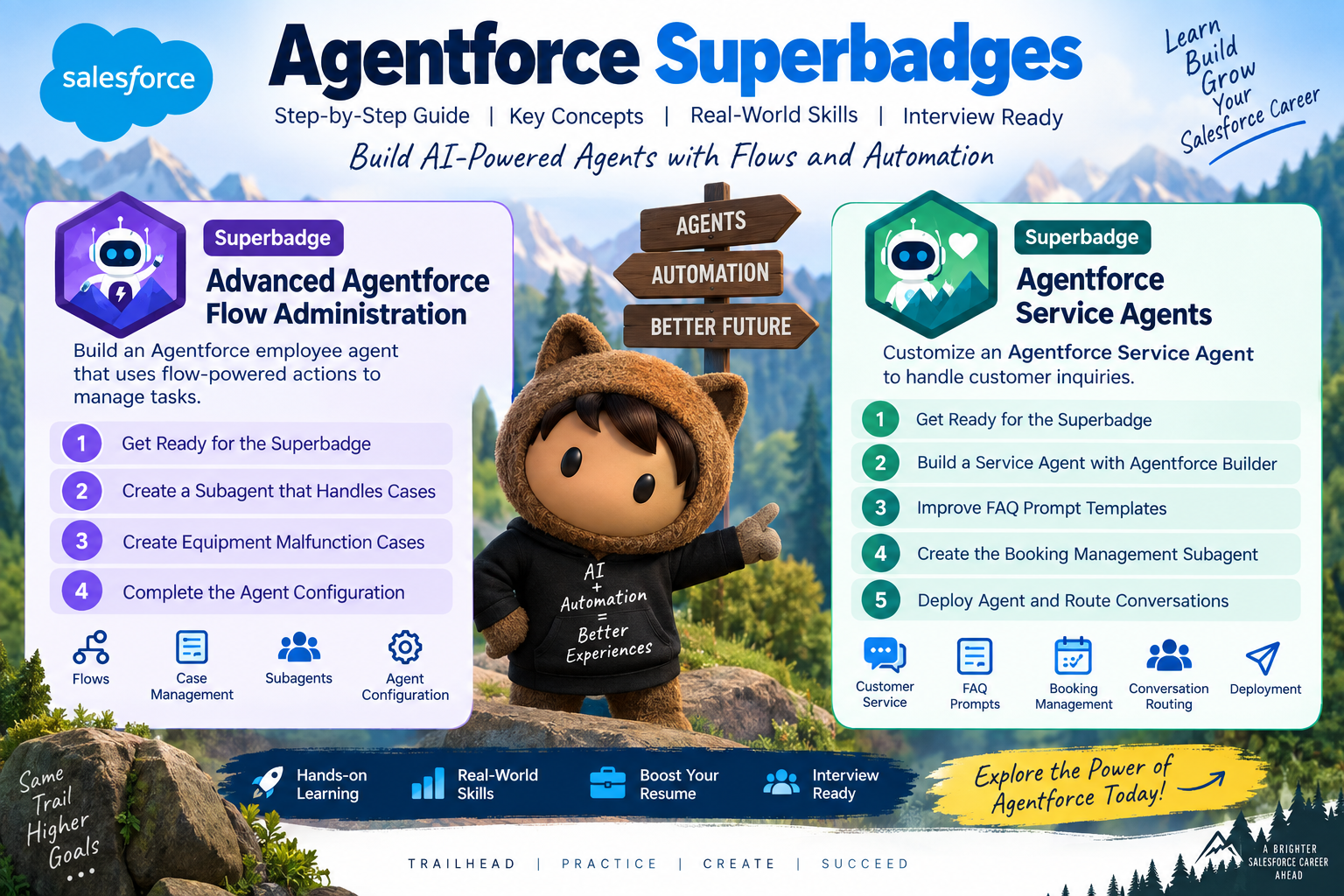
If you are learning Agentforce or preparing for a Salesforce Developer/Admin role, the Agentforce Advanced Flow Administration and Agentforce Service Agents Superbadges are excellent hands-on exercises.
These Superbadges help you understand how to configure Agentforce agents, build subagents, create flow-powered actions, handle cases, improve FAQ responses, and deploy service agents.
In this guide, we’ll cover both Superbadges, their units, key concepts, and the skills you can gain from completing them.
1. Superbadge: Advanced Agentforce Flow Administration
What is this Superbadge?
The Advanced Agentforce Flow Administration Superbadge focuses on building an Agentforce employee agent that uses Flow-powered actions to perform business tasks.
Instead of creating an AI agent that only answers questions, you configure an agent that can interact with Salesforce automation and perform actions based on employee requests.
What You’ll Learn
By completing this Superbadge, you can practice:
- Agentforce employee agents
- Agent configuration
- Agent subagents
- Salesforce Flow
- Flow-powered agent actions
- Case creation
- Business process automation
- Agent instructions
- Testing agent behavior
Unit 1: Get Ready for the Superbadge — Agentforce Advanced Flow Administration
The first unit prepares your Salesforce environment for the challenges.
The objective is to make sure the required Salesforce features, data, and configuration are available before building the agent.
Key Areas
You typically work with:
- Agentforce
- Salesforce Flow
- Employee Agent
- Agent actions
- Cases
- Topics/subagents
- Salesforce objects and fields
Important Concept
Agentforce can use actions to connect an AI conversation with Salesforce automation.
A simplified architecture looks like:
Employee
   ↓
Agentforce Employee Agent
   ↓
Subagent / Topic
   ↓
Agent Action
   ↓
Salesforce Flow
   ↓
Salesforce Record
For example:
Employee:
"My laptop is not working."

        ↓

Agentforce

        ↓

Equipment Malfunction Subagent

        ↓

Flow Action

        ↓

Create Case

        ↓

Case Created
This is one of the most important concepts to understand before attempting the later challenges.
Unit 2: Create a Subagent that Handles Cases
In this unit, you create a subagent that specializes in handling cases.
A subagent allows an Agentforce agent to focus on a specific business area.
For example:
Employee Agent
│
├── Case Management Subagent
│
├── Equipment Subagent
│
└── HR Subagent
Each subagent can have its own instructions and actions.
Why Use Subagents?
Subagents help organize agent functionality.
Instead of putting every instruction and action into one large agent, you can separate responsibilities.
For example:
User Request
     ↓
Agent
     ↓
Identify Intent
     ↓
Route to Subagent
     ↓
Execute Action
This approach makes an agent easier to configure, test, and maintain.
Unit 3: Create Equipment Malfunction Cases
This unit focuses on creating cases when employees report equipment problems.
Imagine an employee says:
“My company laptop isn’t working.”
The Agentforce agent can understand the request and use a Flow-powered action to create a Case.
Example Flow
Start
  ↓
Receive Agent Inputs
  ↓
Set Case Information
  ↓
Create Case
  ↓
Return Case Number
  ↓
End
The Flow may work with information such as:
- Case Subject
- Description
- Priority
- Status
- Origin
- Contact/Employee
- Equipment details
Example Scenario
Employee:
My laptop won't turn on.
Agent:
I can create an equipment malfunction case for you.
Flow:
Create Case
Subject = Laptop Not Working
Priority = High
Status = New
Agent:
Your equipment malfunction case has been created.
The important lesson is that Agentforce handles the conversation while Flow performs the Salesforce automation.
Unit 4: Complete the Agent Configuration
The final unit brings the components together.
You need to ensure that the agent has:
- Correct instructions
- Correct subagents
- Correct actions
- Correct Flow configuration
- Correct permissions
- Correct routing
- Proper testing
Recommended Testing
Test multiple types of requests:
"My laptop is broken."

"My monitor isn't working."

"I need help with my equipment."

"Create a case for my keyboard problem."
The agent should identify the appropriate intent and invoke the correct action.
Key Learning
A production Agentforce implementation should not simply rely on AI-generated answers.
It should combine:
AI
+
Business Instructions
+
Salesforce Data
+
Flow Automation
+
Security
2. Superbadge: Agentforce Service Agents
The second Superbadge focuses on building an Agentforce Service Agent that can handle customer inquiries.
This Superbadge is especially useful for understanding how Agentforce can be used in customer service environments.
What You’ll Learn
You’ll work with:
- Agentforce Service Agents
- Agentforce Builder
- Prompt Templates
- FAQ responses
- Subagents
- Booking management
- Customer conversations
- Agent deployment
- Conversation routing
Unit 1: Get Ready for the Superbadge — Agentforce Service Agents
This unit prepares the Salesforce environment for the Service Agent challenges.
Before building the agent, you need to understand the available:
- Salesforce data
- Agent configuration
- Service processes
- Prompt templates
- Agent actions
- Customer service requirements
The goal is to establish the foundation for the Service Agent.
Unit 2: Build a Service Agent with Agentforce Builder
Agentforce Builder provides the configuration environment for building and managing an Agentforce agent.
A simplified architecture looks like:
Customer
   ↓
Agentforce Service Agent
   ↓
Identify Customer Intent
   ↓
Select Topic/Subagent
   ↓
Use Knowledge / Prompt / Action
   ↓
Respond to Customer
Example
Customer:
What is your cancellation policy?
The agent can identify the FAQ-related request and provide an appropriate answer.
For transactional requests, the agent can route the conversation to a specialized subagent.
Unit 3: Improve FAQ Prompt Templates
Prompt templates are important because they help control how the agent generates responses.
Instead of relying on a generic instruction, you can provide clear requirements for how the agent should answer customer questions.
Example Prompt Structure
Role:
You are a helpful customer service agent.

Goal:
Answer customer FAQ questions accurately.

Instructions:
- Use approved information.
- Do not invent policies.
- Keep answers concise.
- Ask for clarification when necessary.
- Escalate when the request requires human assistance.
Why Prompt Design Matters
A good prompt can help improve:
- Accuracy
- Consistency
- Relevance
- Tone
- Customer experience
The goal is not simply to make the response sound natural.
The agent must provide information that follows the organization’s business rules.
Unit 4: Create the Booking Management Subagent
This unit focuses on creating a specialized subagent for booking-related conversations.
For example:
Customer
   ↓
Service Agent
   ↓
Booking Request
   ↓
Booking Management Subagent
   ↓
Booking Action
   ↓
Response
A customer might ask:
"I want to change my booking."
The Service Agent can identify the request and route it to the Booking Management Subagent.
The subagent can then use the appropriate Salesforce action or automation.
Example Conversation
Customer:
I want to modify my booking.

Agent:
Sure. What would you like to change?

Customer:
I need to change the booking date.

Agent:
I can help with that. Please provide your booking number.
The important concept is specialization.
The main agent manages the overall conversation while the booking subagent focuses specifically on booking operations.
Unit 5: Deploy Agent and Route Conversations
After building and testing the Service Agent, the final step is deployment.
The agent needs to be configured so that customer conversations can be routed to it.
A simplified service architecture is:
Customer
   ↓
Service Channel
   ↓
Agentforce Service Agent
   ↓
Intent Detection
   ↓
Subagent
   ↓
Action / Knowledge / Prompt
   ↓
Customer Response
Before Deployment
Always test:
- FAQ questions
- Booking requests
- Invalid requests
- Missing information
- Unexpected questions
- Escalation scenarios
- Agent actions
- Conversation routing
Agentforce Advanced Flow Administration vs Agentforce Service Agents
| Area | Advanced Flow Administration | Agentforce Service Agents |
|---|---|---|
| Primary Focus | Employee automation | Customer service |
| Agent Type | Employee Agent | Service Agent |
| Flow | Major focus | Can support actions |
| Subagents | Yes | Yes |
| Cases | Equipment malfunction cases | Service-related scenarios |
| Prompt Templates | Agent instructions | FAQ prompt templates |
| Booking | Not primary focus | Booking Management |
| Deployment | Agent configuration | Service deployment & routing |
| Main Skill | Flow-powered automation | Customer service automation |
Important Agentforce Architecture
The two Superbadges together demonstrate an important Agentforce architecture:
                 Agentforce
                     │
          ┌──────────┴──────────┐
          │                     │
     Employee Agent       Service Agent
          │                     │
      Subagents             Subagents
          │                     │
       Actions                Actions
          │                     │
        Flow             Prompt / Data / Flow
          │                     │
     Salesforce              Salesforce
       Records                Records
This demonstrates how AI agents can be connected to Salesforce business processes.
Key Skills You Can Mention on Your Resume
After completing these Superbadges, you can highlight practical exposure to:
- Agentforce
- Agentforce Builder
- Agentforce Service Agents
- Employee Agents
- Agent Subagents
- Flow-powered Agent Actions
- Salesforce Flow
- Prompt Templates
- FAQ Automation
- Case Management
- Booking Management
- Conversation Routing
- Agent Configuration
- AI-powered Salesforce Automation
Example Resume Bullet
Salesforce Agentforce: Built and configured Agentforce employee and service agents using subagents, Flow-powered actions, prompt templates, case automation, booking management, and conversation routing.
Interview Questions Based on These Superbadges
1. What is an Agentforce subagent?
A subagent is a specialized component of an Agentforce solution that handles a specific business area or type of user request.
2. How can Flow be used with Agentforce?
Salesforce Flow can provide automation that an Agentforce agent invokes through an action. The Flow can then create or update Salesforce records or perform business logic.
3. Why use subagents?
Subagents allow different business capabilities to be separated into focused areas, making the overall agent easier to configure and manage.
4. What is the difference between an Employee Agent and a Service Agent?
An Employee Agent is designed to assist internal employees, while a Service Agent is designed to support customer service interactions.
5. Why are prompt templates important?
Prompt templates provide structured instructions that help an AI system generate responses according to specific business requirements.
6. How would you test an Agentforce agent?
Test common requests, edge cases, missing information, invalid requests, actions, routing, and escalation scenarios before deployment.
Final Takeaway
The Advanced Agentforce Flow Administration and Agentforce Service Agents Superbadges provide hands-on experience with two important Agentforce use cases.
The first focuses heavily on:
Agent + Subagent + Flow + Action + Case
The second focuses on:
Service Agent + Prompt + Subagent + Booking + Routing
Together, they demonstrate how Salesforce can combine AI-driven conversations with structured automation and Salesforce business data.
For Salesforce professionals, these exercises are valuable because they move beyond simply configuring an AI chatbot and introduce the broader concept of AI agents that can understand requests, select appropriate capabilities, execute Salesforce actions, and support business processes.
If you’re preparing for an Agentforce Admin, Salesforce Developer, Salesforce AI Specialist, or Salesforce Service Cloud interview, these Superbadges can also serve as practical project examples to discuss during interviews.
🔥Superbadge: Advanced Agentforce Flow Administration
https://trailheadtitanshub.com/product/superbadge-advanced-agentforce-flow-administration/
🔥Superbadge Agentforce Service Agents
https://trailheadtitanshub.com/product/superbadge-agentforce-service-agents/