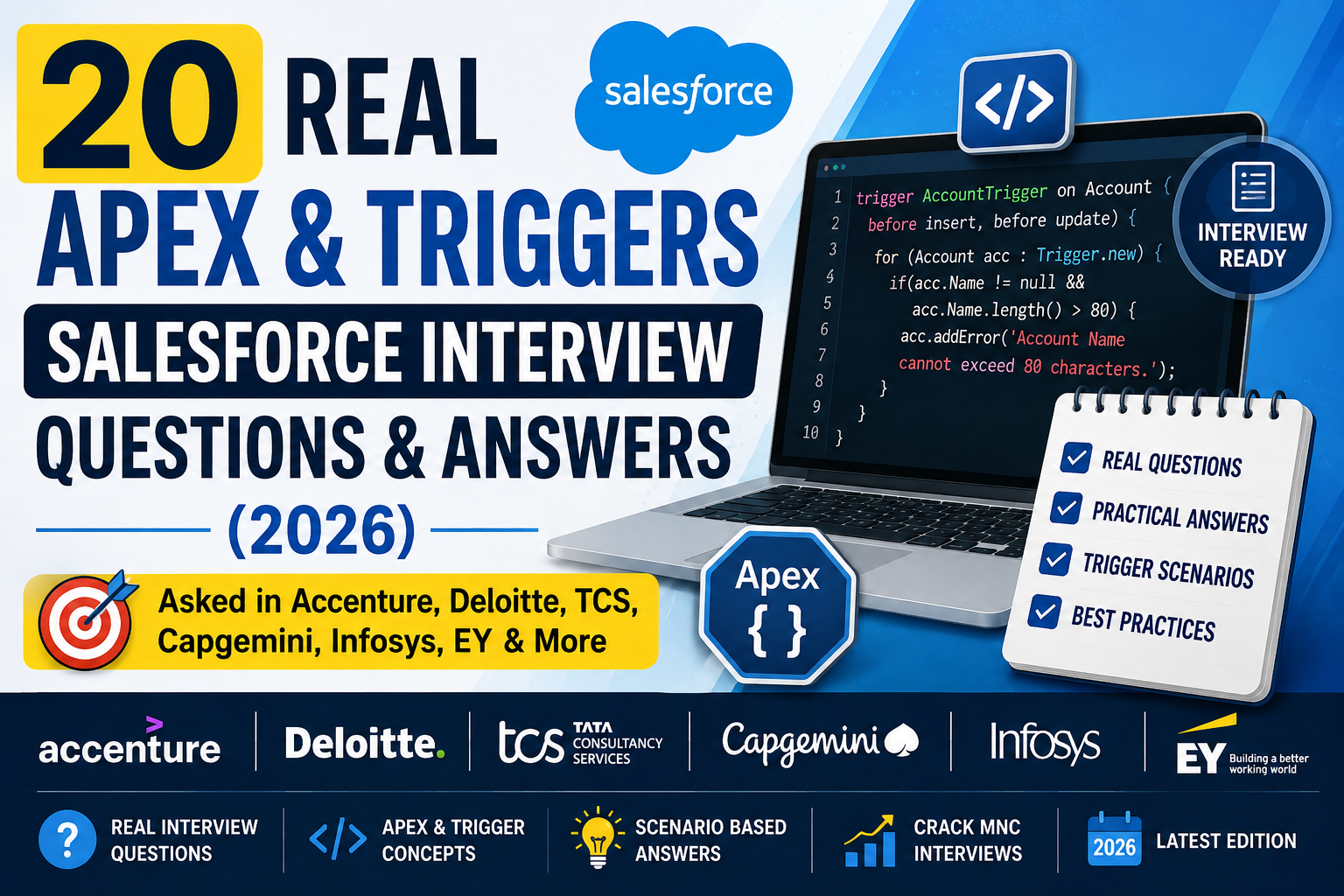
EY – Top 10 Data Engineer Interview Questions (3–8 Years Experience) with Detailed Answers (2026)
1. Explain an end-to-end ETL pipeline you built in your recent project.
Interviewer Intent
The interviewer wants to understand whether you have worked on a complete production data pipeline rather than isolated tasks.
Sample Answer
In my recent project, I developed an end-to-end ETL pipeline for processing customer transaction data coming from multiple sources including SQL Server, REST APIs, and CSV files uploaded daily.
The pipeline consisted of four major stages.
Step 1: Data Ingestion
- Azure Data Factory was scheduled every hour.
- It extracted data from:
- SQL Database
- REST API
- Azure Blob Storage
- Data was copied into Azure Data Lake Storage Gen2.
Step 2: Data Processing
The raw data was processed using Databricks notebooks written in PySpark.
During transformation, I performed:
- Null handling
- Duplicate removal
- Schema validation
- Data type conversion
- Business rule implementation
- Currency conversion
- Timestamp standardization
Example:
df = df.dropDuplicates(["CustomerID","OrderID"])

df = df.withColumn(
    "OrderAmount",
    col("OrderAmount").cast("double")
)
Step 3: Data Validation
Before loading data:
- Record count validation
- Null validation
- Duplicate validation
- Referential integrity check
- Custom business validations
If validation failed:
- Pipeline moved data to quarantine folder.
- Email alerts were sent.
Step 4: Data Loading
Processed data was loaded into
- Delta Lake
- Azure Synapse Analytics
Fact and Dimension tables were updated using MERGE.
Monitoring
Pipeline monitoring included
- Azure Monitor
- Log Analytics
- Databricks Job Monitoring
- ADF Alerts
Result
- Processing time reduced from 5 hours to 45 minutes.
- Improved data quality by implementing automated validation.
- Reduced manual intervention by 90%.
2. How do you optimize PySpark jobs handling large datasets?
Interviewer Intent
Checks your understanding of Spark internals and performance tuning.
Sample Answer
Whenever I optimize PySpark jobs, I follow multiple strategies.
Partitioning
Avoid too few or too many partitions.
df = df.repartition(200)Filter Early
Push filters before joins.
df.filter(col("Status")=="Active")Broadcast Small Tables
from pyspark.sql.functions import broadcast

result = largeDF.join(
    broadcast(smallDF),
    "CustomerID"
)
Avoid UDFs
Use built-in Spark functions because they are optimized.
Bad
myUDF()Good
upper(col("Name"))Cache Frequently Used Data
df.cache()Avoid Wide Transformations
Reduce unnecessary shuffles.
Optimize File Size
Instead of many tiny files:
df.coalesce(20)Delta Optimization
OPTIMIZE Sales;

VACUUM Sales RETAIN 168 HOURS;
Result
These optimizations reduced runtime from nearly 2 hours to 30 minutes.
3. How do you handle Slowly Changing Dimensions (SCD Type 1 & Type 2)?
Sample Answer
Slowly Changing Dimensions track changes in dimension data.
SCD Type 1
Old value is overwritten.
Example
Customer changes email.
Old
Rahul
rahul@gmail.com
New
Rahul
rahul@yahoo.com
No history maintained.
SQL
UPDATE Customer
SET Email='rahul@yahoo.com'
WHERE CustomerID=101;
SCD Type 2
History is preserved.
Instead of updating:
Old record becomes inactive.
New record inserted.
| Customer | Start Date | End Date | Current | |
|---|---|---|---|---|
| Rahul | gmail | 2023 | 2025 | No |
| Rahul | yahoo | 2025 | 9999 | Yes |
Using Delta MERGE
MERGE INTO CustomerDimension
USING Updates
Real Project
Customer address changes required historical reporting.
Implemented SCD Type 2 using Delta MERGE.
4. Explain the difference between Delta Lake, Data Lake, and Data Warehouse.
| Feature | Data Lake | Delta Lake | Data Warehouse |
|---|---|---|---|
| Purpose | Raw Storage | Reliable Lake | Analytics |
| Schema | Schema-on-read | Schema Enforcement | Schema-on-write |
| ACID | No | Yes | Yes |
| Versioning | No | Yes | Yes |
| Performance | Medium | High | Very High |
| Updates | Difficult | Easy | Easy |
Answer
A Data Lake stores raw structured, semi-structured, and unstructured data. It provides flexibility but lacks built-in transactional guarantees and strong data governance.
Delta Lake builds on top of a Data Lake by adding ACID transactions, schema enforcement, time travel, versioning, and optimized read/write performance. This makes it ideal for reliable, production-grade data engineering pipelines.
A Data Warehouse stores cleaned, curated, and structured business data optimized for reporting, dashboards, and analytical queries. It typically uses a schema-on-write approach and supports fast SQL-based analytics.
In my projects, Azure Data Lake Storage serves as the landing zone for raw data, Delta Lake is used for transformation and reliable storage, and Azure Synapse Analytics functions as the enterprise data warehouse for business reporting.
5. How would you design a scalable data pipeline using Azure Data Factory or Databricks?
Sample Answer
A scalable pipeline should support increasing data volume, fault tolerance, and easy maintenance.
Architecture
Source Systems
     │
     ▼
Azure Data Factory
     │
     ▼
Azure Data Lake (Raw)
     │
     ▼
Databricks (Bronze)
     │
     ▼
Databricks (Silver)
     │
     ▼
Databricks (Gold)
     │
     ▼
Azure Synapse
     │
     ▼
Power BI
Key Design Principles
- Metadata-driven pipelines to reduce code duplication.
- Incremental loading using watermark columns.
- Parameterized ADF pipelines for reusability.
- Auto-scaling Databricks clusters.
- Delta Lake for ACID transactions and optimized storage.
- Monitoring with Azure Monitor and Log Analytics.
- CI/CD using Azure DevOps or Git integration.
This architecture enables high throughput, easy maintenance, and cost optimization while supporting future scalability.
6. What techniques do you use to improve SQL query performance?
Sample Answer
SQL optimization starts with understanding execution plans and identifying bottlenecks.
Techniques I Follow
- Create appropriate indexes on frequently filtered and joined columns.
- Avoid
SELECT *; retrieve only required columns. - Filter data as early as possible using the
WHEREclause. - Use partitioning for very large tables.
- Replace correlated subqueries with joins where appropriate.
- Keep statistics updated.
- Minimize unnecessary sorting and grouping.
- Use Common Table Expressions (CTEs) only when they improve readability without affecting performance.
Example
Instead of:
SELECT *
FROM Orders;
Use:
SELECT OrderID,
       CustomerID,
       OrderDate
FROM Orders
WHERE OrderDate >= '2026-01-01';
In one production project, rewriting a complex query and adding proper indexing reduced execution time from 25 minutes to under 3 minutes.
7. How do you handle late-arriving data and duplicate records?
Sample Answer
Late-arriving data is common in distributed systems where source systems may send delayed records.
Handling Late-Arriving Data
- Use watermark columns based on event timestamps.
- Perform incremental processing with configurable lookback windows.
- Upsert records using Delta Lake
MERGE. - Reprocess historical partitions if required.
Handling Duplicate Records
- Use business keys instead of relying solely on surrogate keys.
- Remove duplicates using
dropDuplicates()in PySpark. - Implement unique constraints where supported.
- Compare hash values to identify duplicate content.
Example:
df = df.dropDuplicates(["CustomerID", "TransactionID"])This ensures data consistency while avoiding duplicate reporting and incorrect aggregations.
8. Explain your approach to data quality checks in production pipelines.
Sample Answer
Data quality is critical because inaccurate data leads to incorrect business decisions.
Validation Framework
I implement multiple validation layers:
- Schema validation
- Null checks
- Duplicate detection
- Data type validation
- Range validation
- Referential integrity checks
- Business rule validation
- Record count reconciliation
Error Handling
- Invalid records are moved to a quarantine area.
- Detailed logs capture validation failures.
- Alerts are sent to support teams.
- Valid records continue processing to avoid blocking the entire pipeline.
This automated framework significantly improves reliability and reduces manual investigation efforts.
9. How do you monitor and troubleshoot failed data pipelines?
Sample Answer
Monitoring begins with proactive alerting rather than reactive troubleshooting.
Monitoring Tools
- Azure Monitor
- Azure Data Factory Monitoring
- Databricks Job Monitoring
- Log Analytics
- Application Insights (where applicable)
Troubleshooting Steps
- Identify the failed pipeline activity.
- Review detailed error logs.
- Check source system availability.
- Validate schema changes.
- Verify cluster health and resource utilization.
- Retry failed activities after resolving the root cause.
- Document the issue to prevent recurrence.
Common production failures include expired credentials, schema drift, storage limits, network connectivity issues, and malformed input files.
10. Describe a challenging production issue you resolved and your approach.
Sample Answer
One significant production issue occurred when our daily pipeline suddenly failed after a source application introduced a new column into a CSV file without prior notification.
Problem
- Pipeline failure due to schema mismatch.
- Downstream reporting was delayed.
- SLA risk for business stakeholders.
My Approach
- Investigated Azure Data Factory logs.
- Identified the schema change in the source file.
- Updated the PySpark transformation to support schema evolution.
- Enabled schema validation with controlled evolution.
- Tested the pipeline in a lower environment.
- Reprocessed failed data.
- Added automated schema drift detection and notification for future changes.
Outcome
- Production restored within one hour.
- No data loss occurred.
- Introduced automated schema monitoring, preventing similar incidents and improving overall pipeline resilience.
Final Interview Tip
For EY Data Engineer interviews (3–8 years), interviewers often evaluate more than technical knowledge. Structure your answers around real project experience using this simple format:
- Project Context – What business problem were you solving?
- Architecture – Which technologies and cloud services did you use?
- Implementation – Explain your role, design decisions, and code or SQL where relevant.
- Challenges – Describe the production issues you encountered and how you resolved them.
- Results – Quantify the impact (e.g., reduced processing time, improved data quality, cost savings, SLA improvements).
Deloitte – Top 10 Data Engineer Interview Questions (3–8 Years Experience) with Detailed Answers (2026)
1. Design a Data Pipeline for Processing Billions of Records Daily
Why Interviewers Ask This
Deloitte works with enterprise-scale clients where data volumes can reach billions of records every day. Interviewers want to evaluate your ability to design scalable, fault-tolerant, and cost-efficient data pipelines.
Sample Answer
In one of my recent projects, we built a cloud-based data pipeline capable of processing more than 2 billion records daily from multiple source systems, including transactional databases, APIs, IoT devices, and flat files.
The architecture was designed using the Medallion Architecture (Bronze, Silver, Gold) to ensure scalability, maintainability, and data quality.
High-Level Architecture
Multiple Sources
(SQL Server | Oracle | REST APIs | Kafka | CSV Files)

            │
            ▼

Azure Data Factory / Apache Airflow

            │
            ▼

Azure Data Lake Storage (Raw/Bronze)

            │
            ▼

Azure Databricks (PySpark)

            │
            ▼

Silver Layer
(Cleaned & Validated Data)

            │
            ▼

Gold Layer
(Business Aggregations)

            │
            ▼

Azure Synapse Analytics

            │
            ▼

Power BI / Tableau
Step 1 – Data Ingestion
Data arrived from multiple sources.
I used:
- Azure Data Factory
- Kafka
- REST APIs
- Incremental database extraction
Data landed inside Azure Data Lake Storage.
Step 2 – Data Processing
Databricks notebooks processed data using PySpark.
Transformation included:
- Data cleansing
- Schema validation
- Duplicate removal
- Business rule implementation
- Data enrichment
- Standardization
Example:
df = df.dropDuplicates(["CustomerID","OrderID"])

df = df.filter(col("Status")=="Active")
Step 3 – Data Quality
Validation included:
- Null checks
- Duplicate checks
- Record count validation
- Business validations
- Schema validation
Invalid data moved into Quarantine Storage.
Step 4 – Gold Layer
Business KPIs were created.
Examples:
- Sales Summary
- Revenue by Region
- Customer Lifetime Value
- Daily Revenue
Step 5 – Reporting
Gold tables loaded into:
- Azure Synapse
- Power BI
Performance Optimizations
I used
- Partition pruning
- Broadcast joins
- Delta OPTIMIZE
- Z-Ordering
- Auto Scaling Clusters
- Incremental processing
Result
The pipeline processed over 2 billion records daily, achieved 99.9% SLA compliance, and reduced processing time from 7 hours to under 2 hours while lowering infrastructure costs by nearly 30%.
2. Explain How You Optimize Spark Jobs for Performance
Why Interviewers Ask This
Spark optimization is one of Deloitte’s favorite topics because large-scale analytics depends heavily on efficient Spark processing.
Sample Answer
Whenever I optimize Spark jobs, I first identify bottlenecks using the Spark UI and execution plans.
Partition Management
Too many partitions create overhead, while too few reduce parallelism.
df = df.repartition(300)Broadcast Joins
For small lookup tables:
from pyspark.sql.functions import broadcast

result = fact.join(
    broadcast(dim),
    "CustomerID"
)
Filter Early
Apply filters before joins.
df = df.filter(col("Country")=="India")Avoid UDFs
Instead of
myUDF()Use
upper(col("Name"))Cache Frequently Used Data
df.cache()Optimize Delta Tables
OPTIMIZE Sales;

VACUUM Sales;
Enable Adaptive Query Execution
spark.conf.set(
"spark.sql.adaptive.enabled",
"true"
)
Result
These optimizations reduced job execution time by nearly 70%, significantly decreased shuffle operations, and improved overall cluster utilization.
3. How Do You Implement Change Data Capture (CDC)?
Why Interviewers Ask This
Most enterprise systems cannot reload entire datasets every day. CDC enables efficient incremental data processing.
Sample Answer
CDC captures only the records that have changed since the previous execution.
There are multiple CDC approaches.
Timestamp-Based CDC
Uses LastModifiedDate.
SELECT *
FROM Orders
WHERE LastModifiedDate >
:lastRunTime;
SQL Server CDC
Tracks Inserts
Updates
Deletes
Automatically.
Delta MERGE
MERGE INTO Customer
USING Updates
ON Customer.ID=Updates.ID

WHEN MATCHED THEN
UPDATE SET *

WHEN NOT MATCHED
THEN INSERT *
Advantages
- Faster processing
- Lower compute cost
- Smaller data movement
- Better scalability
Real Project
Our customer table contained 250 million records.
Instead of loading everything daily, CDC reduced processing to only 500,000 changed records, cutting execution time from 5 hours to 20 minutes.
4. Explain the Medallion Architecture (Bronze, Silver, Gold)
Why Interviewers Ask This
The Medallion Architecture is a standard design pattern for modern lakehouse platforms such as Databricks.
Sample Answer
The Medallion Architecture organizes data into multiple layers based on its quality and business readiness.
Bronze Layer (Raw Data)
- Stores source data exactly as received
- No transformations
- Used for auditing and recovery
Silver Layer (Clean Data)
- Removes duplicates
- Standardizes formats
- Applies schema validation
- Implements business rules
Gold Layer (Business Data)
- Aggregated data
- Business KPIs
- Reporting tables
- Dashboard-ready datasets
Architecture Diagram
Bronze
↓
Raw Data

↓

Silver
↓
Validated Data

↓

Gold
↓
Business Metrics
Benefits
- Better governance
- Improved data quality
- Easier debugging
- Scalable architecture
- Supports machine learning and reporting
5. How Do You Handle Schema Evolution in Production?
Why Interviewers Ask This
Source systems evolve over time by adding, removing, or modifying columns. A production pipeline must handle these changes without causing failures.
Sample Answer
Schema evolution allows a pipeline to adapt to changes while protecting downstream systems.
My Approach
- Enable schema evolution in Delta Lake where appropriate.
- Maintain schema versions in metadata repositories.
- Compare incoming schemas with expected schemas before processing.
- Alert support teams when breaking changes occur.
- Use backward-compatible transformations whenever possible.
Example:
df.write.format("delta") \
.option("mergeSchema","true") \
.mode("append") \
.save(path)
Best Practices
- Never ignore schema changes silently.
- Validate new columns before exposing them to reporting.
- Use automated schema drift detection.
This approach minimizes downtime while maintaining data integrity.
6. What Are the Best Practices for Partitioning Large Datasets?
Sample Answer
Partitioning improves query performance by reducing the amount of data scanned.
Best Practices
- Partition using high-cardinality business columns only when appropriate.
- Common partition columns include:
- Year
- Month
- Date
- Region
- Avoid creating thousands of tiny partitions.
- Combine small files using compaction.
- Monitor partition skew regularly.
- Use partition pruning to reduce scan time.
Example:
df.write \
.partitionBy("OrderDate") \
.format("delta") \
.save(path)
Proper partitioning can dramatically improve performance and reduce storage costs.
7. How Do You Secure Sensitive Data in Cloud Data Platforms?
Why Interviewers Ask This
Security is critical in industries such as banking, healthcare, and retail, where sensitive customer information must be protected.
Sample Answer
I follow a layered security approach.
Identity and Access
- Azure Active Directory authentication
- Role-Based Access Control (RBAC)
- Principle of least privilege
Data Protection
- Encryption at rest
- Encryption in transit
- Customer-managed encryption keys where required
Sensitive Data Protection
- Dynamic data masking
- Column-level security
- Row-level security
- Tokenization
- Data masking for non-production environments
Monitoring
- Azure Monitor
- Audit logs
- Microsoft Defender for Cloud
These controls help organizations comply with regulations such as GDPR and other industry standards while protecting sensitive information.
8. Explain Your Experience with Azure Data Factory, Airflow, or Similar Orchestration Tools
Sample Answer
I have extensive experience using Azure Data Factory (ADF) for enterprise ETL orchestration and Apache Airflow for workflow scheduling.
Azure Data Factory
Responsibilities included:
- Pipeline development
- Parameterized pipelines
- Incremental loading
- Scheduling
- Monitoring
- Retry mechanisms
- Dependency management
- Integration with Databricks and Synapse
Apache Airflow
Used for:
- DAG creation
- Workflow dependencies
- Retry logic
- Email alerts
- Dynamic scheduling
Example Workflow
Extract
↓

Validate

↓

Transform

↓

Load

↓

Notify
ADF was primarily used in Azure-native environments, while Airflow was preferred for multi-cloud and open-source orchestration requirements.
9. How Would You Migrate an On-Premises Data Warehouse to the Cloud?
Sample Answer
A successful migration requires careful planning to minimize downtime and maintain data consistency.
Step 1 – Assessment
- Inventory existing databases
- Identify dependencies
- Analyze workloads
Step 2 – Choose Cloud Architecture
Example:
- Azure Data Lake
- Azure Data Factory
- Databricks
- Azure Synapse Analytics
Step 3 – Data Migration
- Perform initial full load
- Configure CDC for incremental synchronization
- Validate migrated data
Step 4 – Testing
- Functional testing
- Performance testing
- Reconciliation of record counts and business metrics
Step 5 – Cutover
- Schedule final synchronization
- Redirect applications
- Monitor post-migration performance
A phased migration strategy significantly reduces risk and business disruption.
10. Describe a Production Issue Where Data Was Missing or Duplicated. How Did You Resolve It?
Why Interviewers Ask This
Deloitte interviewers often use behavioral questions to understand your problem-solving skills in real production environments.
Sample Answer
One production incident involved duplicate customer transactions appearing in daily reports.
Problem
An upstream API retried failed requests without proper idempotency, causing duplicate records to be ingested into the data lake.
Investigation
- Reviewed Azure Data Factory pipeline logs.
- Compared source transaction IDs.
- Identified repeated API payloads.
- Confirmed duplicate records in the Bronze layer.
Resolution
- Introduced composite business keys using
CustomerIDandTransactionID. - Removed duplicates using PySpark:
df = df.dropDuplicates(["CustomerID", "TransactionID"])- Replaced append logic with Delta Lake
MERGEfor idempotent upserts. - Added monitoring to detect abnormal duplicate rates.
Outcome
- Eliminated duplicate reporting.
- Restored business trust in analytics.
- Reduced similar incidents through proactive monitoring and improved pipeline design.
Final Interview Tip
For Deloitte Data Engineer interviews (3–8 years), technical knowledge alone is not enough. Deloitte interviewers typically look for candidates who can combine architecture design, coding expertise, cloud engineering, production troubleshooting, and business impact.
When answering technical questions, follow this proven structure:
- Business Scenario – Briefly explain the project or business requirement.
- Architecture – Describe the end-to-end solution, including ingestion, storage, processing, orchestration, and reporting.
- Implementation – Discuss the technologies, frameworks, and design decisions you used (for example, PySpark, Azure Data Factory, Databricks, Delta Lake, Airflow, or Synapse).
- Challenges – Highlight real production issues, bottlenecks, or failures you encountered and how you resolved them.
- Business Impact – End with measurable outcomes such as reduced processing time, improved data quality, cost savings, higher SLA compliance, or increased pipeline reliability.
PwC – Top 10 Data Engineer Interview Questions (3–8 Years Experience) with Detailed Answers (2026)
PwC looks for Data Engineers who can build reliable, scalable, and business-focused data solutions. While technical expertise is essential, interviewers also evaluate your understanding of data governance, cloud platforms, production support, and your ability to communicate technical concepts clearly. The questions below are commonly asked for candidates with 3–8 years of experience.
1. Explain Your End-to-End Data Engineering Project
Why Interviewers Ask This
This question helps interviewers understand your overall project experience, your technical responsibilities, and how well you understand the complete data lifecycle.
Sample Answer
In my recent project, I developed an end-to-end data engineering solution for a retail organization that collected customer transactions from multiple channels such as e-commerce websites, point-of-sale systems, ERP databases, and third-party APIs.
The primary goal was to create a centralized analytics platform that provided near real-time business insights.
Project Architecture
Source Systems
(SQL Server | Oracle | REST APIs | CSV Files)

        │
        ▼

Azure Data Factory

        │
        ▼

Azure Data Lake Storage (Raw)

        │
        ▼

Azure Databricks (PySpark)

        │
        ▼

Delta Lake
(Bronze → Silver → Gold)

        │
        ▼

Azure Synapse Analytics

        │
        ▼

Power BI
Data Ingestion
I used Azure Data Factory to:
- Extract data from SQL Server, Oracle, REST APIs, and flat files.
- Schedule hourly and daily data loads.
- Perform incremental loading using watermark columns.
- Store raw data in Azure Data Lake Storage Gen2.
Data Transformation
Azure Databricks with PySpark handled:
- Data cleansing
- Duplicate removal
- Data type conversion
- Business rule implementation
- Null handling
- Currency conversion
- Date standardization
Example:
df = df.dropDuplicates(["CustomerID","OrderID"])

df = df.filter(col("Status")=="Completed")
Data Validation
Validation included:
- Record count verification
- Null checks
- Duplicate detection
- Schema validation
- Business rule validation
- Referential integrity checks
Invalid records were written to a quarantine location for further analysis.
Data Loading
Processed data was stored in Delta Lake.
Business-ready Gold tables were loaded into Azure Synapse for reporting.
Monitoring
Pipeline monitoring included:
- Azure Monitor
- Azure Data Factory Monitoring
- Databricks Job Monitoring
- Email alerts
- Automatic retries
Business Impact
- Processed over 800 million records daily.
- Reduced pipeline runtime from 6 hours to 1.5 hours.
- Improved data quality by 95%.
- Reduced manual intervention through automated validation and monitoring.
2. How Do You Design Scalable ETL Pipelines?
Why Interviewers Ask This
PwC works with large enterprise clients where pipelines must support increasing data volumes while remaining reliable and maintainable.
Sample Answer
A scalable ETL pipeline should be modular, fault-tolerant, reusable, and capable of handling future growth.
My Design Principles
Separate Ingestion, Transformation, and Consumption
Each layer should perform a single responsibility.
Metadata-Driven Design
Instead of hardcoding source details, maintain metadata tables.
Benefits:
- Reusability
- Easier onboarding of new sources
- Reduced development effort
Incremental Loading
Rather than reloading complete datasets:
Use
- Watermark columns
- CDC
- Delta MERGE
Parallel Processing
Run independent pipelines simultaneously.
Auto Scaling
Enable Databricks auto-scaling clusters.
Monitoring
Implement:
- Logging
- Alerts
- Retry mechanisms
- Pipeline dependency management
Benefits
- Faster execution
- Lower infrastructure costs
- Easier maintenance
- Better fault tolerance
3. What Techniques Do You Use for SQL Optimization?
Why Interviewers Ask This
SQL remains one of the most important skills for Data Engineers.
Sample Answer
I optimize SQL queries by reducing unnecessary I/O, improving execution plans, and minimizing expensive operations.
Common Optimization Techniques
Use Proper Indexes
Create indexes on:
- Join columns
- Filter columns
- Frequently searched fields
Avoid SELECT *
Instead of
SELECT *
FROM Orders;
Use
SELECT
OrderID,
CustomerID,
OrderDate
FROM Orders;
Filter Early
WHERE OrderDate >= '2026-01-01'Optimize Joins
Join smaller datasets first when appropriate and ensure join keys are indexed.
Avoid Functions on Indexed Columns
Bad:
WHERE YEAR(OrderDate)=2026Better:
WHERE OrderDate >= '2026-01-01'Review Execution Plans
Identify:
- Table scans
- Missing indexes
- Expensive sort operations
- Hash joins
- Nested loop inefficiencies
Result
One optimized reporting query improved from 18 minutes to under 2 minutes, significantly enhancing dashboard refresh performance.
4. Explain Delta Lake Features and Benefits
Why Interviewers Ask This
Delta Lake has become a standard storage layer for modern cloud-based data engineering solutions.
Sample Answer
Delta Lake extends a traditional data lake by adding transactional reliability and performance optimizations.
Key Features
ACID Transactions
Supports reliable concurrent read and write operations.
Schema Enforcement
Prevents accidental insertion of invalid data.
Schema Evolution
Allows controlled addition of new columns without disrupting existing pipelines.
Time Travel
Access previous versions of data.
Example:
SELECT *
FROM Sales VERSION AS OF 5;
MERGE Support
Efficiently performs UPSERT operations.
MERGE INTO Sales
USING Updates
Performance Optimizations
- OPTIMIZE
- VACUUM
- Z-Ordering
- Data skipping
- File compaction
Benefits
- Improved reliability
- Better performance
- Easier auditing
- Faster analytics
- Simplified incremental loading
5. How Do You Implement Data Validation and Reconciliation?
Why Interviewers Ask This
Accurate data is critical for financial reporting, auditing, and regulatory compliance.
Sample Answer
I implement validation at multiple stages of the pipeline.
Validation Checks
- Record count validation
- Null checks
- Duplicate detection
- Data type validation
- Mandatory field validation
- Business rule validation
- Foreign key validation
Reconciliation
Compare:
Source Record Count
↓
Landing Record Count
↓
Processed Record Count
↓
Warehouse Record Count
Any mismatch triggers alerts and investigation.
Logging
Store:
- Batch ID
- Timestamp
- Records Processed
- Failed Records
- Validation Results
Benefits
- Improved data trust
- Easier auditing
- Faster issue resolution
6. How Do You Optimize Joins in Spark?
Why Interviewers Ask This
Spark joins are often the biggest performance bottleneck in distributed processing.
Sample Answer
Join optimization depends on data size and distribution.
Broadcast Joins
For small lookup tables:
from pyspark.sql.functions import broadcast

result = fact.join(
broadcast(dim),
"CustomerID"
)
Repartition Before Join
fact = fact.repartition("CustomerID")Filter Before Joining
Reduce dataset size before expensive joins.
Avoid Data Skew
Handle skewed keys using salting or repartitioning.
Enable AQE
spark.conf.set(
"spark.sql.adaptive.enabled",
"true"
)
Cache Frequently Used Data
fact.cache()Result
These optimizations reduced shuffle size by 60% and decreased execution time from 90 minutes to 25 minutes.
7. Explain Batch Processing vs Streaming Processing
Why Interviewers Ask This
Organizations increasingly require both scheduled analytics and real-time insights.
Sample Answer
Batch Processing
Processes large volumes of accumulated data at scheduled intervals.
Examples:
- Daily sales reports
- Payroll
- Financial reconciliation
- Monthly billing
Advantages:
- High throughput
- Lower infrastructure costs
- Simpler implementation
Streaming Processing
Processes data continuously as events arrive.
Examples:
- Fraud detection
- IoT monitoring
- Real-time recommendations
- Live dashboards
Advantages:
- Low latency
- Immediate insights
- Faster decision-making
Comparison
| Feature | Batch Processing | Streaming Processing |
|---|---|---|
| Processing | Scheduled | Continuous |
| Latency | Minutes to Hours | Seconds or Milliseconds |
| Use Cases | Reporting | Real-Time Analytics |
| Cost | Lower | Higher |
| Complexity | Moderate | High |
8. How Do You Ensure Data Governance and Compliance?
Why Interviewers Ask This
PwC serves highly regulated industries where governance, privacy, and compliance are mandatory.
Sample Answer
Data governance ensures data is secure, trustworthy, and compliant with organizational policies and regulatory requirements.
My Approach
Access Control
- Role-Based Access Control (RBAC)
- Least privilege principle
- Azure Active Directory integration
Data Classification
Classify:
- Public
- Internal
- Confidential
- Restricted
Data Encryption
- Encryption at rest
- Encryption in transit
- Customer-managed keys where required
Sensitive Data Protection
- Data masking
- Tokenization
- Row-level security
- Column-level security
Auditing
Maintain logs for:
- Data access
- Pipeline executions
- User activity
- Schema changes
Compliance
Ensure adherence to:
- GDPR
- HIPAA (where applicable)
- SOX (for financial reporting)
- Organization-specific policies
9. How Do You Handle Pipeline Failures in Production?
Why Interviewers Ask This
Production failures are inevitable. Interviewers want to understand your troubleshooting methodology.
Sample Answer
Whenever a production pipeline fails, I follow a structured incident management process.
Step 1
Identify the failed activity.
Step 2
Review:
- Azure Data Factory logs
- Databricks logs
- Spark UI
- Application logs
Step 3
Determine root cause.
Common issues include:
- Schema changes
- Source connectivity failures
- Expired credentials
- Memory issues
- Corrupted files
Step 4
Resolve issue.
Examples:
- Update schema
- Retry failed activity
- Increase cluster resources
- Restore missing files
Step 5
Validate results.
Ensure:
- No data loss
- No duplicate records
- Successful reconciliation
Step 6
Implement preventive measures.
- Better monitoring
- Automated alerts
- Improved validation
- Documentation
10. Describe a Project Where You Significantly Improved Pipeline Performance
Why Interviewers Ask This
This behavioral question measures your practical experience and ability to deliver measurable business value.
Sample Answer
One analytics pipeline processed approximately 1.2 billion transaction records every night.
Initially, the pipeline required almost 8 hours, causing delays in business reporting.
Root Causes
- Small file problem
- Poor partitioning
- Shuffle-heavy joins
- Unnecessary full data loads
- Lack of caching
Improvements Implemented
- Switched to incremental loading using CDC.
- Repartitioned data by business keys.
- Implemented broadcast joins for lookup tables.
- Replaced Python UDFs with built-in Spark functions.
- Enabled Adaptive Query Execution.
- Used Delta Lake
OPTIMIZEandZ-ORDER. - Compacted small files to improve read efficiency.
Business Results
- Reduced processing time from 8 hours to 2 hours.
- Lowered cloud infrastructure costs by approximately 35%.
- Improved dashboard availability before business hours.
- Increased SLA compliance from 92% to 99.8%.
- Reduced operational support effort through proactive monitoring and optimized pipeline design.
Final Interview Tip
For PwC Data Engineer interviews (3–8 years), interviewers expect candidates to demonstrate both strong technical expertise and a clear understanding of business value. When answering any question, structure your response using this framework:
- Business Context – Explain the problem or business requirement.
- Solution Design – Describe the architecture, cloud services, and technologies used.
- Implementation – Discuss your role, coding approach, and engineering decisions.
- Challenges – Highlight production issues or technical obstacles and how you resolved them.
- Business Impact – Conclude with measurable outcomes such as improved performance, cost savings, enhanced data quality, stronger compliance, or increased reliability.
KPMG – Top 10 Data Engineer Interview Questions (3–8 Years Experience) with Detailed Answers (2026)
KPMG works with clients across banking, insurance, healthcare, retail, manufacturing, and government sectors, where data engineering projects require scalability, security, compliance, and reliability. During interviews, candidates are expected to demonstrate hands-on experience with cloud platforms, big data technologies, ETL design, data governance, and production support.
If you have 3–8 years of experience, the following questions are among the most frequently asked in KPMG Data Engineer interviews.
1. Explain Your Current Data Architecture
Why Interviewers Ask This
This question evaluates whether you understand the complete data ecosystem rather than just writing ETL code. Interviewers want to know how data flows from source systems to business users.
Sample Answer
In my current project, we built a modern cloud-based data platform using Azure services to process structured and semi-structured data from multiple enterprise systems.
The architecture follows a layered approach that separates raw, cleansed, and business-ready data to improve scalability, governance, and maintainability.
High-Level Architecture
Source Systems
(SQL Server | Oracle | SAP | REST APIs | CSV Files)

        │
        ▼

Azure Data Factory

        │
        ▼

Azure Data Lake Storage Gen2

        │
        ▼

Azure Databricks (PySpark)

        │
        ▼

Delta Lake
Bronze → Silver → Gold

        │
        ▼

Azure Synapse Analytics

        │
        ▼

Power BI / Tableau
Step 1 – Data Ingestion
Data is extracted from:
- SQL Server
- Oracle
- SAP
- REST APIs
- FTP servers
- CSV and JSON files
Azure Data Factory orchestrates ingestion using parameterized pipelines and scheduled triggers.
Step 2 – Raw Data Storage
All incoming data is stored in the Bronze layer within Azure Data Lake Storage without modification. This preserves the original source for auditing and recovery.
Step 3 – Data Processing
Azure Databricks notebooks written in PySpark perform:
- Data cleansing
- Duplicate removal
- Schema validation
- Data type conversion
- Business rule implementation
- Data enrichment
Example:
df = df.dropDuplicates(["CustomerID","OrderID"])

df = df.filter(col("Status") == "Completed")
Step 4 – Curated Data
Validated data moves to the Silver layer, where quality checks and standardization are completed. Business-ready datasets are then published to the Gold layer for analytics.
Step 5 – Reporting
Gold tables are loaded into Azure Synapse Analytics, enabling Power BI dashboards and ad hoc reporting.
Monitoring
We monitor pipelines using:
- Azure Monitor
- Azure Data Factory Monitoring
- Databricks Job Monitoring
- Log Analytics
- Email notifications
Business Impact
- Processed over 1 billion records daily.
- Reduced processing time from 7 hours to less than 2 hours.
- Improved data quality and SLA compliance through automated monitoring and validation.
2. How Do You Design a Data Lakehouse Solution?
Why Interviewers Ask This
Many organizations are adopting the Lakehouse architecture because it combines the flexibility of a data lake with the reliability and performance of a data warehouse.
Sample Answer
A Data Lakehouse stores raw data while providing transactional reliability, governance, and optimized analytics.
Architecture
Source Systems

↓

Azure Data Factory

↓

Azure Data Lake Storage

↓

Bronze Layer

↓

Silver Layer

↓

Gold Layer

↓

Azure Synapse / Power BI
Bronze Layer
Stores raw data exactly as received.
Purpose:
- Historical archive
- Audit
- Recovery
- Replay
Silver Layer
Contains cleaned and validated data.
Activities include:
- Null handling
- Duplicate removal
- Standardization
- Schema validation
- Business transformations
Gold Layer
Contains aggregated and business-ready datasets used for:
- Executive dashboards
- KPI reporting
- Machine Learning
- Data Science
Technologies
- Azure Data Lake Storage
- Azure Databricks
- Delta Lake
- Azure Synapse
- Power BI
Benefits
- ACID transactions
- High scalability
- Better governance
- Time Travel
- Schema Evolution
- Faster analytical queries
- Lower storage costs
3. What Is Data Partitioning, and When Would You Use It?
Why Interviewers Ask This
Partitioning is one of the most important optimization techniques for handling large datasets efficiently.
Sample Answer
Data partitioning divides a large dataset into smaller logical segments, allowing Spark and SQL engines to read only the required partitions instead of scanning the entire dataset.
Example
Instead of storing all sales data in one location:
Sales/

2024/

2025/

2026/
Spark reads only the required year when filtering by date.
Common Partition Columns
- Year
- Month
- Order Date
- Country
- Region
PySpark Example
df.write \
.partitionBy("OrderDate") \
.format("delta") \
.save(path)
Best Practices
- Choose columns frequently used in filters.
- Avoid over-partitioning that creates many small files.
- Monitor partition skew.
- Periodically compact small files.
Benefits
- Faster query performance
- Lower storage I/O
- Reduced processing cost
- Better scalability
4. Explain Broadcast Joins and Shuffle Joins in Spark
Why Interviewers Ask This
Join optimization is critical because joins often account for the largest portion of Spark execution time.
Sample Answer
Broadcast Join
A Broadcast Join sends a small lookup table to every executor, avoiding network shuffling.
Example:
from pyspark.sql.functions import broadcast

result = fact.join(
    broadcast(dim),
    "CustomerID"
)
When to Use
- Dimension tables
- Lookup tables
- Small reference datasets
Shuffle Join
Shuffle Joins redistribute data across executors before performing the join.
They are used when both datasets are large.
Comparison
| Feature | Broadcast Join | Shuffle Join |
|---|---|---|
| Data Size | Small + Large | Large + Large |
| Network Shuffle | No | Yes |
| Performance | Faster | Slower |
| Memory Requirement | Higher on Executors | Lower |
Best Practice
Use Broadcast Joins only when the lookup table comfortably fits into executor memory. Otherwise, Spark automatically uses Shuffle Joins.
5. How Do You Implement Incremental Loading?
Why Interviewers Ask This
Reloading billions of records daily is inefficient. Incremental loading improves performance and reduces costs.
Sample Answer
Incremental loading processes only new or modified records since the previous execution.
Common Techniques
Timestamp-Based Loading
SELECT *
FROM Orders
WHERE LastModifiedDate >
:lastRunTime;
Change Data Capture (CDC)
Capture:
- Inserts
- Updates
- Deletes
Delta MERGE
MERGE INTO Customer
USING Updates
ON Customer.ID = Updates.ID

WHEN MATCHED THEN
UPDATE SET *

WHEN NOT MATCHED
THEN INSERT *
Benefits
- Faster execution
- Lower compute cost
- Reduced storage usage
- Improved scalability
Real Project
Instead of processing 450 million records, incremental loading reduced daily processing to approximately 700,000 changed records, reducing runtime from 4 hours to 25 minutes.
6. How Do You Manage Metadata in Data Engineering Projects?
Why Interviewers Ask This
Metadata management improves automation, governance, and maintainability across large enterprise data platforms.
Sample Answer
Metadata describes data rather than storing the actual business data.
Types of Metadata
Technical Metadata
- Table names
- Column names
- Data types
- File locations
Business Metadata
- Business definitions
- Data ownership
- Business rules
Operational Metadata
- Pipeline execution history
- Batch IDs
- Processing timestamps
- Record counts
- Error logs
Metadata Repository
I maintain metadata tables containing:
- Source system details
- Load frequency
- Watermark values
- Pipeline parameters
- Validation rules
- Target mappings
This enables metadata-driven ETL pipelines, making it easier to onboard new datasets without changing application code.
7. Explain Your Experience with Azure Databricks or Snowflake
Why Interviewers Ask This
KPMG projects commonly use Azure Databricks, Snowflake, or both depending on client requirements.
Sample Answer
Azure Databricks
I use Databricks for:
- ETL development
- PySpark transformations
- Delta Lake implementation
- Machine Learning preparation
- Workflow automation
Key features I have worked with include:
- Auto Scaling Clusters
- Delta Lake
- Unity Catalog
- Notebooks
- Job Scheduling
Snowflake
I have experience with:
- Virtual Warehouses
- Snowpipe
- Time Travel
- Zero Copy Cloning
- Secure Data Sharing
- Streams and Tasks
Example Project
Data arrived through Azure Data Factory, was transformed in Databricks using PySpark, stored in Delta Lake, and finally loaded into Snowflake for enterprise reporting and analytics.
8. How Do You Secure Data Pipelines?
Why Interviewers Ask This
Security is essential because enterprise pipelines often process personally identifiable information (PII), financial records, and other sensitive business data.
Sample Answer
I implement multiple layers of security.
Authentication
- Azure Active Directory
- Service Principals
- Managed Identities
Authorization
- Role-Based Access Control (RBAC)
- Least Privilege Principle
Data Protection
- Encryption at Rest
- Encryption in Transit
- Customer-Managed Keys
Sensitive Data Handling
- Data Masking
- Tokenization
- Row-Level Security
- Column-Level Security
Monitoring
- Azure Monitor
- Audit Logs
- Microsoft Defender for Cloud
- Security Alerts
These measures help protect sensitive information while supporting regulatory requirements such as GDPR, HIPAA (where applicable), and organization-specific compliance standards.
9. How Do You Debug Slow-Running ETL Jobs?
Why Interviewers Ask This
Performance optimization is a common responsibility for experienced Data Engineers.
Sample Answer
When an ETL job runs slowly, I follow a structured troubleshooting process.
Step 1 – Review Monitoring Tools
- Spark UI
- Azure Monitor
- Databricks Job Logs
- Pipeline execution history
Step 2 – Identify Bottlenecks
Check for:
- Data skew
- Excessive shuffling
- Small file problem
- Long-running joins
- Inefficient SQL
Step 3 – Apply Optimizations
- Broadcast small lookup tables.
- Repartition datasets appropriately.
- Filter data before joins.
- Replace Python UDFs with native Spark functions.
- Cache frequently reused datasets.
- Enable Adaptive Query Execution (AQE).
- Optimize Delta tables using
OPTIMIZEandZ-ORDER.
Result
In one project, these optimizations reduced ETL runtime from 5 hours to less than 90 minutes, while significantly lowering cluster resource consumption.
10. Describe a Complex Data Migration Project You Worked On
Why Interviewers Ask This
Migration projects demonstrate planning, problem-solving, and enterprise-scale implementation skills.
Sample Answer
One of my most challenging projects involved migrating a legacy on-premises SQL Server data warehouse to Microsoft Azure.
Project Challenges
- Over 15 TB of historical data.
- More than 300 ETL jobs.
- Hundreds of reporting dashboards.
- Strict weekend migration window.
- Zero tolerance for data loss.
Migration Strategy
Phase 1 – Assessment
- Identified source systems.
- Mapped dependencies.
- Documented ETL workflows.
Phase 2 – Initial Data Load
Migrated historical data into Azure Data Lake Storage using Azure Data Factory.
Phase 3 – Incremental Synchronization
Implemented Change Data Capture (CDC) to synchronize ongoing changes while users continued working on the legacy platform.
Phase 4 – Validation
Performed:
- Record count reconciliation
- Data quality validation
- Business rule verification
- Dashboard comparison
Phase 5 – Production Cutover
Completed final synchronization during the planned maintenance window and redirected reporting applications to the cloud platform.
Business Results
- Successfully migrated 15 TB of enterprise data with zero data loss.
- Reduced ETL execution time by approximately 60%.
- Lowered infrastructure costs by 35% after cloud optimization.
- Improved scalability, disaster recovery capabilities, and overall reporting performance.
Final Interview Tip
For KPMG Data Engineer interviews (3–8 years), interviewers value candidates who can think beyond writing ETL code. They expect engineers who understand architecture, governance, security, cloud platforms, scalability, and business impact.
When answering technical questions, use this five-step framework:
- Business Requirement – Explain the problem the organization needed to solve.
- Architecture – Describe the end-to-end solution, including data ingestion, storage, transformation, orchestration, and reporting.
- Implementation – Discuss the technologies, frameworks, and design decisions you used (such as Azure Data Factory, Databricks, Delta Lake, Snowflake, or Synapse).
- Challenges – Share real production issues or migration challenges and explain how you resolved them.
- Business Impact – Finish with measurable outcomes such as reduced processing time, improved scalability, enhanced data quality, lower cloud costs, or stronger compliance.
Accenture – Top 10 Data Engineer Interview Questions (3–8 Years Experience) with Detailed Answers (2026)
Accenture is one of the world’s largest technology consulting firms, delivering cloud, AI, data engineering, and digital transformation projects for global enterprises. For Data Engineer roles (3–8 years of experience), interviewers assess your ability to design scalable architectures, optimize big data workloads, automate deployments, and solve production issues while delivering measurable business value.
The following are among the most frequently asked Accenture Data Engineer interview questions, along with detailed, blog-style answers.
1. Explain Your Most Challenging Data Engineering Project
Why Interviewers Ask This
This question helps interviewers evaluate your technical depth, problem-solving ability, leadership, and communication skills. They want to know how you handled a real production challenge from start to finish.
Sample Answer
One of the most challenging projects I worked on involved building a cloud-native data platform for a multinational retail company. The objective was to process data from multiple countries, consolidate it into a single analytics platform, and provide near real-time dashboards for business users.
The biggest challenge was handling massive data volumes while ensuring high availability, data quality, and low processing latency.
Project Architecture
Source Systems
(SQL Server | Oracle | SAP | REST APIs | Kafka)

            │
            ▼

Azure Data Factory

            │
            ▼

Azure Data Lake Storage Gen2

            │
            ▼

Azure Databricks (PySpark)

            │
            ▼

Delta Lake
Bronze → Silver → Gold

            │
            ▼

Azure Synapse Analytics

            │
            ▼

Power BI
My Responsibilities
I was responsible for:
- Designing ETL workflows
- Developing PySpark transformation logic
- Implementing Delta Lake architecture
- Creating incremental loading using CDC
- Optimizing Spark performance
- Monitoring production pipelines
- Supporting production incidents
Major Challenges
The project initially suffered from:
- Slow Spark jobs
- Small file problem
- Duplicate records
- Schema changes
- Long-running joins
- Increasing cloud costs
Solutions Implemented
I introduced:
- Delta Lake
- Partition pruning
- Broadcast joins
- Auto-scaling Databricks clusters
- Incremental loading
- Automated monitoring
- Data quality framework
Business Results
- Processed over 1.5 billion records daily
- Reduced ETL runtime from 8 hours to 2 hours
- Lowered Azure compute costs by approximately 30%
- Improved SLA compliance from 93% to 99.8%
2. How Do You Optimize Spark Transformations?
Why Interviewers Ask This
Spark optimization is one of the most important technical skills for experienced Data Engineers.
Sample Answer
When optimizing Spark transformations, my goal is to reduce execution time, minimize shuffling, and improve resource utilization.
Apply Filters Early
Reduce unnecessary processing.
df = df.filter(col("Status") == "Active")Use Built-in Spark Functions
Instead of Python UDFs:
upper(col("CustomerName"))Native Spark functions are optimized by the Catalyst Optimizer.
Broadcast Small Lookup Tables
from pyspark.sql.functions import broadcast

result = fact.join(
    broadcast(dim),
    "CustomerID"
)
Repartition Large Data
df = df.repartition("CustomerID")Cache Frequently Used Data
df.cache()Enable Adaptive Query Execution
spark.conf.set(
    "spark.sql.adaptive.enabled",
    "true"
)
Optimize Delta Tables
OPTIMIZE Sales;

ZORDER BY(CustomerID);
Business Impact
These optimizations reduced shuffle operations by 65% and improved job performance by nearly 70%.
3. Explain Delta Live Tables (DLT)
Why Interviewers Ask This
Delta Live Tables is increasingly used to automate reliable and maintainable ETL pipelines on Databricks.
Sample Answer
Delta Live Tables (DLT) is a declarative framework in Databricks that simplifies building, testing, and monitoring ETL pipelines.
Instead of manually managing dependencies, DLT automatically handles pipeline execution and data lineage.
Key Features
- Automatic dependency management
- Built-in data quality expectations
- Incremental processing
- Pipeline monitoring
- Automatic retries
- Event logging
- Data lineage
Example
import dlt

@dlt.table
def customers():
    return spark.read.table("bronze_customers")
Benefits
- Less code
- Easier maintenance
- Better reliability
- Faster development
- Built-in monitoring
Real Project
We replaced multiple manual Databricks notebooks with Delta Live Tables, reducing maintenance effort by 40% and improving pipeline reliability.
4. How Do You Implement CDC Using Databricks?
Why Interviewers Ask This
Incremental processing is essential when working with enterprise-scale datasets.
Sample Answer
Change Data Capture (CDC) processes only new or modified records instead of reloading entire tables.
Common CDC Sources
- SQL Server CDC
- Oracle GoldenGate
- Debezium
- Kafka
- Delta Change Data Feed (CDF)
Delta MERGE Example
MERGE INTO Customer
USING Updates

ON Customer.CustomerID =
Updates.CustomerID

WHEN MATCHED THEN
UPDATE SET *

WHEN NOT MATCHED THEN
INSERT *
Delta Change Data Feed
ALTER TABLE Sales

SET TBLPROPERTIES
(delta.enableChangeDataFeed = true);
Advantages
- Faster processing
- Lower cloud cost
- Smaller data movement
- Better scalability
Business Result
Instead of processing 900 million records, CDC reduced daily processing to approximately 600,000 changed records, cutting execution time from 5 hours to 30 minutes.
5. How Do You Schedule and Monitor Pipelines?
Why Interviewers Ask This
Building pipelines is only part of the job. Maintaining reliable production operations is equally important.
Sample Answer
In my projects, I primarily use Azure Data Factory and Databricks Workflows for orchestration.
Scheduling
- Time-based triggers
- Event-based triggers
- Dependency-based execution
- Parameterized pipelines
Monitoring
I monitor pipelines using:
- Azure Monitor
- Azure Data Factory Monitoring
- Databricks Job Dashboard
- Log Analytics
- Email alerts
- Microsoft Teams notifications
Failure Handling
I configure:
- Retry policies
- Timeout settings
- Failure notifications
- Error logging
- Automatic restart where appropriate
Benefits
This approach minimizes downtime and enables rapid incident response while improving overall pipeline reliability.
6. Explain the Difference Between cache() and persist() in Spark
Why Interviewers Ask This
This is a popular Spark interview question that tests your understanding of Spark memory management.
Sample Answer
Both cache() and persist() store intermediate datasets to avoid recomputation, but they differ in storage flexibility.
cache()
- Stores data in memory by default.
- Equivalent to:
df.persist(StorageLevel.MEMORY_ONLY)Example:
df.cache()persist()
Allows different storage levels.
Example:
from pyspark import StorageLevel

df.persist(StorageLevel.MEMORY_AND_DISK)
Comparison
| Feature | cache() | persist() |
|---|---|---|
| Default Storage | Memory Only | Configurable |
| Storage Options | No | Yes |
| Suitable For | Small datasets | Large datasets |
| Flexibility | Limited | High |
Best Practice
Use cache() for smaller datasets that comfortably fit in memory. Use persist() when datasets are large or memory limitations require disk storage as a fallback.
7. How Do You Optimize Cloud Storage Costs?
Why Interviewers Ask This
Cloud cost optimization is an important responsibility for modern Data Engineers.
Sample Answer
I optimize storage costs through efficient data management and lifecycle policies.
My Strategies
- Use incremental loading instead of full reloads.
- Compress files using Parquet or Delta formats.
- Compact small files regularly.
- Archive cold data to lower-cost storage tiers.
- Remove obsolete data using retention policies.
- Optimize Delta tables with
VACUUM.
Example:
VACUUM Sales RETAIN 168 HOURS;Additional Techniques
- Partition data appropriately.
- Remove duplicate data.
- Avoid storing unnecessary intermediate files.
- Enable lifecycle management policies.
Business Result
These optimizations reduced monthly storage costs by approximately 25% while improving query performance.
8. What Data Modeling Techniques Have You Used?
Why Interviewers Ask This
Interviewers want to understand your experience designing data structures that support reporting, analytics, and operational workloads.
Sample Answer
I have worked with multiple data modeling techniques based on business requirements.
Star Schema
- Central fact table
- Multiple dimension tables
- Optimized for reporting and Power BI dashboards
Snowflake Schema
- Normalized dimensions
- Reduced data redundancy
- Better suited for complex enterprise models
Data Vault
Used for:
- Historical tracking
- Enterprise data warehousing
- Regulatory reporting
Medallion Architecture
- Bronze
- Silver
- Gold
This layered approach improves governance, data quality, and maintainability.
Example
For retail analytics, I designed a Star Schema consisting of:
- FactSales
- DimCustomer
- DimProduct
- DimStore
- DimDate
This significantly improved reporting performance and simplified business analysis.
9. Explain Your CI/CD Process for Data Engineering
Why Interviewers Ask This
Modern data engineering teams use DevOps practices to automate deployments and improve code quality.
Sample Answer
I follow a structured CI/CD pipeline using Azure DevOps and Git.
Development Workflow
- Develop code in feature branches.
- Commit changes to Git.
- Create Pull Requests.
- Perform peer code reviews.
- Run automated validation and testing.
- Deploy to Development.
- Promote to QA/UAT.
- Deploy to Production after approval.
Deployment Components
- Azure Data Factory pipelines
- Databricks notebooks
- ARM templates
- Infrastructure as Code
- Parameter files
- Secrets managed through Azure Key Vault
Benefits
- Faster releases
- Fewer deployment errors
- Better collaboration
- Easy rollback
- Consistent environments
10. Describe a Production Issue and How You Fixed It
Why Interviewers Ask This
Behavioral questions help interviewers assess your troubleshooting approach and ability to work under pressure.
Sample Answer
One production incident occurred when our daily sales pipeline suddenly failed due to an unexpected schema change in the source system.
Problem
The source application added two new columns without prior notification, causing downstream transformations to fail.
Investigation
I reviewed:
- Azure Data Factory logs
- Databricks job logs
- Spark execution history
The root cause was identified as a schema mismatch.
Resolution
I:
- Enabled schema evolution in Delta Lake.
- Updated PySpark transformations to support optional columns.
- Validated downstream compatibility.
- Reprocessed failed batches.
- Added automated schema drift detection and alerts.
Example:
df.write.format("delta") \
.option("mergeSchema", "true") \
.mode("append") \
.save(path)
Business Outcome
- Restored production within 45 minutes.
- Prevented data loss.
- Reduced future schema-related incidents through automated monitoring.
- Improved overall pipeline resilience and reduced operational support effort.
Final Interview Tip
For Accenture Data Engineer interviews (3–8 years), interviewers expect candidates who can combine strong technical expertise with consulting and delivery skills. They look for engineers who not only build scalable pipelines but also optimize performance, automate deployments, manage cloud costs, and resolve production challenges effectively.
When answering interview questions, use this proven structure:
- Business Context – Explain the business problem or requirement.
- Solution Architecture – Describe the end-to-end design, including ingestion, storage, transformation, orchestration, and reporting.
- Implementation – Discuss the technologies, frameworks, and coding practices you used, such as PySpark, Databricks, Delta Lake, Azure Data Factory, or Azure DevOps.
- Challenges – Share real production issues or technical bottlenecks and explain how you resolved them.
- Business Impact – Conclude with measurable results such as reduced processing time, lower cloud costs, improved data quality, increased SLA compliance, or enhanced pipeline reliability.
Capgemini – Top 10 Data Engineer Interview Questions (3–8 Years Experience) with Detailed Answers (2026)
Capgemini is one of the world’s leading consulting and technology services companies, delivering large-scale cloud modernization, analytics, AI, and data engineering solutions across industries such as banking, healthcare, retail, manufacturing, telecommunications, and insurance. For Data Engineer roles (3–8 years of experience), interviewers focus on your ability to design scalable ETL pipelines, optimize Spark and SQL workloads, implement reliable cloud architectures, and troubleshoot production issues.
This guide covers 10 frequently asked Capgemini Data Engineer interview questions along with detailed, interview-ready answers that you can also use for technical blogs.
1. Explain Your ETL Workflow from Source to Target
Why Interviewers Ask This
This question evaluates whether you understand the complete data lifecycle—from extracting raw data to delivering analytics-ready datasets.
Sample Answer
In my current project, I developed an enterprise ETL pipeline that processes customer, sales, and inventory data from multiple source systems into a centralized cloud analytics platform.
The objective was to provide reliable, high-quality data for reporting, dashboards, and machine learning.
High-Level Architecture
Source Systems
(SQL Server | Oracle | SAP | REST APIs | CSV Files)

            │
            ▼

Azure Data Factory

            │
            ▼

Azure Data Lake Storage Gen2
(Raw Layer)

            │
            ▼

Azure Databricks (PySpark)

            │
            ▼

Delta Lake
Bronze → Silver → Gold

            │
            ▼

Azure Synapse Analytics

            │
            ▼

Power BI
Step 1 – Data Extraction
Data is collected from:
- SQL Server
- Oracle
- SAP
- REST APIs
- FTP servers
- CSV and JSON files
Azure Data Factory orchestrates the extraction process using scheduled and event-based triggers.
Step 2 – Data Ingestion
Raw data is stored in Azure Data Lake Storage Gen2.
The Bronze layer preserves data exactly as received, allowing audits and historical reprocessing.
Step 3 – Data Transformation
Databricks notebooks written in PySpark perform:
- Data cleansing
- Duplicate removal
- Data type conversion
- Null handling
- Standardization
- Business rule implementation
- Data enrichment
Example:
from pyspark.sql.functions import col

df = df.dropDuplicates(["CustomerID", "OrderID"])
df = df.filter(col("Status") == "Completed")
Step 4 – Data Validation
Quality checks include:
- Record count validation
- Schema validation
- Null checks
- Duplicate detection
- Business rule validation
- Referential integrity
Invalid records are redirected to a quarantine area for investigation.
Step 5 – Data Loading
Validated data is written to Delta Lake.
Business-ready Gold tables are loaded into Azure Synapse Analytics for reporting and analytics.
Monitoring
Pipeline monitoring includes:
- Azure Monitor
- Azure Data Factory Monitoring
- Databricks Job Monitoring
- Log Analytics
- Email and Microsoft Teams alerts
Business Impact
- Processed more than 900 million records daily.
- Reduced ETL runtime from 6 hours to under 2 hours.
- Improved data quality through automated validation and monitoring.
2. How Do You Optimize SQL Queries?
Why Interviewers Ask This
SQL remains one of the most important skills for Data Engineers, especially when working with large enterprise databases.
Sample Answer
SQL optimization focuses on reducing execution time, minimizing resource usage, and improving query efficiency.
Use Proper Indexes
Create indexes on:
- Join columns
- Filter columns
- Frequently searched fields
Avoid SELECT *
Instead of:
SELECT *
FROM Orders;
Use:
SELECT
OrderID,
CustomerID,
OrderDate
FROM Orders;
Filter Data Early
WHERE OrderDate >= '2026-01-01'This reduces the amount of data processed.
Optimize Joins
- Join on indexed columns.
- Eliminate unnecessary joins.
- Use appropriate join types.
Avoid Functions on Indexed Columns
Instead of:
WHERE YEAR(OrderDate) = 2026Use:
WHERE OrderDate >= '2026-01-01'Analyze Execution Plans
Review execution plans to identify:
- Table scans
- Missing indexes
- Expensive sorts
- Hash joins
- Nested loop issues
Business Result
Optimizing a reporting query reduced execution time from 20 minutes to less than 3 minutes, significantly improving dashboard refresh performance.
3. Explain Partitioning and Bucketing in Spark
Why Interviewers Ask This
Partitioning and bucketing are essential techniques for improving Spark performance and reducing data processing time.
Sample Answer
Partitioning
Partitioning divides data into logical directories based on a column.
Example:
df.write \
.partitionBy("OrderDate") \
.format("delta") \
.save(path)
Common partition columns:
- Year
- Month
- Country
- Region
Benefits
- Partition pruning
- Reduced I/O
- Faster queries
- Lower processing costs
Bucketing
Bucketing distributes data into a fixed number of files using a hash function.
Example:
df.write \
.bucketBy(16, "CustomerID") \
.saveAsTable("Sales")
Benefits
- Faster joins
- Better aggregation performance
- Reduced shuffle operations
Comparison
| Feature | Partitioning | Bucketing |
|---|---|---|
| Directory Structure | Yes | No |
| Based On | Column Value | Hash Function |
| Best For | Filtering | Joins |
| Performance Benefit | Query Pruning | Reduced Shuffle |
Best Practice
Use partitioning for frequently filtered columns and bucketing when optimizing large joins.
4. What Are Delta Lake ACID Transactions?
Why Interviewers Ask This
Delta Lake provides transactional reliability for modern data lakes, making it a critical topic for cloud data engineering.
Sample Answer
Delta Lake extends traditional data lakes by providing ACID transactions, ensuring reliable and consistent data operations.
ACID Properties
Atomicity
A transaction either completes entirely or rolls back completely.
Consistency
Ensures data remains valid before and after each transaction.
Isolation
Multiple users can read and write data concurrently without conflicts.
Durability
Committed changes remain permanent even if a system failure occurs.
Example
MERGE INTO Customer
USING Updates

ON Customer.ID = Updates.ID

WHEN MATCHED THEN
UPDATE SET *

WHEN NOT MATCHED THEN
INSERT *
Additional Delta Lake Features
- Time Travel
- Schema Enforcement
- Schema Evolution
- Data Versioning
- Change Data Feed
- Optimized Reads and Writes
Benefits
- Reliable concurrent processing
- Simplified incremental loading
- Easier recovery
- Improved analytics performance
5. How Do You Handle Malformed Data?
Why Interviewers Ask This
Production pipelines frequently receive corrupted, incomplete, or invalid data. Interviewers want to know how you maintain data quality without disrupting business operations.
Sample Answer
I implement multiple validation layers to detect and isolate malformed data while allowing valid records to continue processing.
Common Issues
- Missing mandatory fields
- Incorrect data types
- Invalid dates
- Corrupted files
- Duplicate records
- Schema mismatches
My Approach
- Validate schema before processing.
- Apply null and format checks.
- Redirect invalid records to a quarantine folder.
- Log detailed error information.
- Notify support teams automatically.
Example:
valid_df = df.filter(col("CustomerID").isNotNull())
invalid_df = df.filter(col("CustomerID").isNull())
Business Result
This framework prevented pipeline failures while improving overall data quality and reducing manual support efforts.
6. Explain Spark Execution Plans
Why Interviewers Ask This
Understanding execution plans helps identify performance bottlenecks and optimize Spark jobs.
Sample Answer
Spark generates an execution plan before running a query.
Stages
- Logical Plan
- Optimized Logical Plan
- Physical Plan
- Execution
Catalyst Optimizer
Spark uses the Catalyst Optimizer to:
- Push filters
- Reorder joins
- Remove unnecessary operations
- Optimize projections
Tungsten Engine
The Tungsten Engine improves:
- Memory management
- CPU utilization
- Code generation
Viewing the Execution Plan
df.explain(True)Benefits
Reviewing execution plans helps identify:
- Expensive shuffles
- Full table scans
- Skewed joins
- Inefficient transformations
7. How Do You Improve Pipeline Reliability?
Why Interviewers Ask This
Reliable pipelines reduce production incidents and improve business confidence in data.
Sample Answer
Pipeline reliability is achieved through proactive monitoring, validation, and fault tolerance.
My Approach
- Parameterized pipelines
- Retry policies
- Dependency management
- Automated alerts
- Data validation
- Incremental processing
- Idempotent pipeline design
- Comprehensive logging
Monitoring
- Azure Monitor
- Databricks Job Dashboard
- Azure Data Factory Monitoring
- Log Analytics
Error Handling
- Retry failed activities.
- Store failed records separately.
- Generate incident notifications.
- Enable automatic recovery where possible.
Business Result
These improvements increased pipeline success rates to 99.9% and significantly reduced production support incidents.
8. What Logging Framework Do You Use?
Why Interviewers Ask This
Logging is essential for troubleshooting, auditing, and monitoring enterprise ETL processes.
Sample Answer
I implement centralized logging across all pipeline components.
Information Logged
- Pipeline name
- Batch ID
- Start and end time
- Record counts
- Error messages
- Execution duration
- User and environment details
Logging Tools
- Azure Monitor
- Log Analytics
- Databricks Logs
- Python
loggingmodule - Spark Event Logs
Example:
import logging

logging.basicConfig(level=logging.INFO)

logging.info("Pipeline Started")
Benefits
- Faster troubleshooting
- Better auditing
- Improved production support
- Enhanced operational visibility
9. How Do You Secure Azure Data Lake?
Why Interviewers Ask This
Protecting enterprise data is a key responsibility for Data Engineers, especially when handling sensitive or regulated information.
Sample Answer
I secure Azure Data Lake using multiple layers of security.
Authentication
- Azure Active Directory
- Managed Identities
- Service Principals
Authorization
- Role-Based Access Control (RBAC)
- Access Control Lists (ACLs)
- Principle of Least Privilege
Data Protection
- Encryption at rest
- Encryption in transit
- Customer-managed encryption keys (where required)
Secret Management
Store credentials securely using Azure Key Vault.
Monitoring
- Azure Monitor
- Microsoft Defender for Cloud
- Audit Logs
- Security Alerts
Business Benefit
These security measures ensure regulatory compliance, protect sensitive information, and provide complete auditability.
10. Describe a Production Incident You Handled
Why Interviewers Ask This
Behavioral questions help interviewers assess your troubleshooting skills, ownership, and ability to work under pressure.
Sample Answer
One production incident occurred when our nightly ETL pipeline failed due to a sudden schema change in a source system.
Problem
A new column was introduced without prior notification, causing downstream transformations to fail and delaying business reports.
Investigation
I reviewed:
- Azure Data Factory pipeline logs
- Databricks job logs
- Spark execution history
The root cause was identified as a schema mismatch.
Resolution
I:
- Enabled schema evolution in Delta Lake.
- Updated PySpark transformation logic.
- Validated downstream compatibility.
- Reprocessed failed data.
- Added automated schema drift detection and notifications.
Example:
df.write.format("delta") \
.option("mergeSchema", "true") \
.mode("append") \
.save(path)
Business Outcome
- Restored production within one hour.
- Prevented data loss.
- Improved monitoring to detect future schema changes automatically.
- Increased overall pipeline reliability and reduced support effort.
Final Interview Tip
For Capgemini Data Engineer interviews (3–8 years), interviewers expect more than just coding expertise. They want engineers who understand end-to-end data engineering, cloud architecture, Spark optimization, data quality, security, monitoring, and production support.
When answering any interview question, follow this simple structure:
- Business Requirement – Explain the problem you were solving.
- Architecture – Describe the end-to-end solution, including ingestion, storage, transformation, orchestration, and reporting.
- Implementation – Discuss the technologies, frameworks, and design decisions you used, such as Azure Data Factory, Databricks, Delta Lake, Spark, or Synapse.
- Challenges – Highlight real production issues or technical bottlenecks and explain how you resolved them.
- Business Impact – Finish with measurable outcomes such as reduced processing time, improved data quality, increased reliability, lower cloud costs, or stronger SLA compliance.
Cognizant – Top 10 Data Engineer Interview Questions (3–8 Years Experience) with Detailed Answers (2026)
Cognizant is one of the leading IT consulting and digital transformation companies, delivering enterprise-scale Data Engineering, AI, Cloud, and Analytics solutions for clients across Banking, Healthcare, Insurance, Retail, Manufacturing, and Life Sciences. For Data Engineer roles (3–8 years of experience), interviewers focus on your ability to design scalable architectures, optimize big data workloads, implement cloud-native solutions, and resolve production issues efficiently.
This guide covers the Top 10 Cognizant Data Engineer Interview Questions, along with detailed, interview-ready answers that are ideal for both technical interview preparation and blogging.
1. Explain Your Current Project Architecture
Why Interviewers Ask This
This is usually the first technical question in a Cognizant interview. The interviewer wants to understand your overall project experience, your role, and how data flows through your solution.
Sample Answer
In my current project, I work on a cloud-based enterprise data platform built on Microsoft Azure. The platform collects data from multiple business systems, processes it using Databricks, and delivers analytics-ready datasets for reporting and machine learning.
The architecture follows the Medallion (Bronze–Silver–Gold) pattern to improve scalability, governance, and maintainability.
Architecture Diagram
                Source Systems
(SQL Server | Oracle | SAP | REST APIs | Kafka | CSV)

                        │
                        ▼

              Azure Data Factory

                        │
                        ▼

          Azure Data Lake Storage Gen2

                        │
                        ▼

       Azure Databricks (PySpark + Delta)

                        │
                        ▼

        Bronze → Silver → Gold Layers

                        │
                        ▼

           Azure Synapse Analytics

                        │
                        ▼

          Power BI / Tableau Reports
Step 1 – Data Ingestion
Data is collected from:
- SQL Server
- Oracle
- SAP
- REST APIs
- Kafka
- CSV and JSON files
Azure Data Factory orchestrates ingestion using scheduled and event-based triggers.
Step 2 – Data Storage
All incoming data is stored in Azure Data Lake Storage Gen2.
The Bronze layer stores raw data exactly as received for auditing and recovery.
Step 3 – Data Transformation
Azure Databricks notebooks written in PySpark perform:
- Data cleansing
- Duplicate removal
- Schema validation
- Null handling
- Data enrichment
- Business rule implementation
Example:
from pyspark.sql.functions import col

df = df.dropDuplicates(["CustomerID", "OrderID"])
df = df.filter(col("Status") == "Completed")
Step 4 – Curated Data
Validated data moves into the Silver layer, while aggregated business datasets are published to the Gold layer for reporting.
Step 5 – Reporting
Gold tables are loaded into Azure Synapse Analytics and visualized using Power BI dashboards.
Monitoring
The solution is monitored using:
- Azure Monitor
- Azure Data Factory Monitoring
- Databricks Job Monitoring
- Log Analytics
- Email and Microsoft Teams alerts
Business Impact
- Processed over 1.2 billion records daily.
- Reduced processing time from 7 hours to under 2 hours.
- Improved data quality and SLA compliance through automated validation and monitoring.
2. How Do You Process TB-Scale Data?
Why Interviewers Ask This
Handling terabytes of data efficiently is a common requirement in enterprise environments. Interviewers want to know how you design scalable and high-performance data pipelines.
Sample Answer
Processing TB-scale data requires distributed computing, optimized storage formats, and efficient resource management.
My Approach
Distributed Processing
Use Apache Spark to distribute workloads across multiple executors.
Incremental Loading
Process only changed data using:
- Watermark columns
- Change Data Capture (CDC)
- Delta Lake MERGE
Efficient File Formats
Store data using:
- Parquet
- Delta Lake
- ORC (when appropriate)
These formats provide compression and predicate pushdown.
Partitioning
Partition large datasets by frequently filtered columns such as:
- Date
- Region
- Country
Cluster Optimization
Enable:
- Auto Scaling
- Adaptive Query Execution (AQE)
- Dynamic resource allocation
Data Quality
Implement validation to ensure that scaling does not compromise accuracy.
Business Result
Using these techniques, our platform processed over 5 TB of data daily, reducing execution time by more than 60% while maintaining SLA compliance.
3. Explain Window Functions with Real-World Examples
Why Interviewers Ask This
Window functions are widely used in analytics, ranking, running totals, and trend analysis. Cognizant interviewers often ask this to assess your SQL and Spark expertise.
Sample Answer
Window functions perform calculations across a set of rows related to the current row without collapsing the result set.
Common Window Functions
ROW_NUMBER()RANK()DENSE_RANK()LAG()LEAD()SUM() OVERAVG() OVER
Example 1 – Latest Customer Order
SELECT
CustomerID,
OrderID,
OrderDate,
ROW_NUMBER() OVER
(
PARTITION BY CustomerID
ORDER BY OrderDate DESC
) AS RN
FROM Orders;
Retrieve only rows where RN = 1.
Example 2 – Employee Salary Ranking
SELECT
EmployeeName,
Department,
Salary,
RANK() OVER
(
PARTITION BY Department
ORDER BY Salary DESC
)
FROM Employees;
Example 3 – Previous Month Sales
SELECT
Month,
Sales,
LAG(Sales)
OVER(ORDER BY Month)
AS PreviousMonthSales
FROM Sales;
Real-World Use Cases
- Customer purchase history
- Top-selling products
- Monthly sales trends
- Fraud detection
- Employee rankings
- Financial reporting
4. How Do You Optimize Spark Jobs?
Why Interviewers Ask This
Spark optimization is one of the most important skills for experienced Data Engineers.
Sample Answer
When optimizing Spark jobs, I focus on minimizing data movement, reducing shuffle operations, and improving cluster utilization.
Optimization Techniques
Filter Early
df = df.filter(col("Status") == "Completed")Broadcast Small Lookup Tables
from pyspark.sql.functions import broadcast

result = fact.join(
broadcast(dim),
"CustomerID"
)
Repartition Large Data
df = df.repartition("CustomerID")Use Built-In Functions
Avoid Python UDFs whenever possible.
Cache Frequently Used Data
df.cache()Enable AQE
spark.conf.set(
"spark.sql.adaptive.enabled",
"true"
)
Optimize Delta Tables
OPTIMIZE Sales;

ZORDER BY(CustomerID);
Business Result
These improvements reduced execution time from 3 hours to under 50 minutes, significantly improving resource utilization.
5. Explain Delta MERGE Operations
Why Interviewers Ask This
Delta MERGE is essential for implementing incremental loading, CDC, and upsert operations.
Sample Answer
The MERGE statement combines INSERT, UPDATE, and DELETE operations into a single transaction.
Example
MERGE INTO Customer
USING Updates

ON Customer.CustomerID =
Updates.CustomerID

WHEN MATCHED THEN
UPDATE SET *

WHEN NOT MATCHED THEN
INSERT *
Common Use Cases
- Change Data Capture (CDC)
- Slowly Changing Dimensions (SCD)
- Incremental loading
- Data synchronization
Benefits
- ACID transactions
- Better performance
- Simplified ETL logic
- Reduced code complexity
6. How Do You Implement SCD Type 2?
Why Interviewers Ask This
Slowly Changing Dimension Type 2 is commonly used to preserve historical data in data warehouses.
Sample Answer
SCD Type 2 stores historical changes by creating a new record whenever a tracked attribute changes.
Example
| CustomerID | City | StartDate | EndDate | Current |
|---|---|---|---|---|
| 101 | Delhi | 2023 | 2025 | No |
| 101 | Mumbai | 2025 | 9999 | Yes |
Implementation Steps
- Detect changes.
- Expire the existing record.
- Insert a new version.
- Mark the latest record as current.
Delta MERGE Example
MERGE INTO CustomerDimension
USING CustomerUpdates
ON CustomerDimension.CustomerID = CustomerUpdates.CustomerID
Business Benefit
Maintaining historical records supports trend analysis, regulatory reporting, and auditing.
7. Explain File Formats (Parquet, ORC, Avro)
Why Interviewers Ask This
Choosing the right file format significantly affects storage efficiency and query performance.
Sample Answer
Parquet
- Columnar format
- High compression
- Predicate pushdown
- Excellent for analytics
ORC
- Columnar format
- Optimized for Hive
- Fast compression and decompression
- Suitable for Hadoop ecosystems
Avro
- Row-based format
- Schema evolution support
- Compact serialization
- Commonly used in streaming pipelines
Comparison
| Feature | Parquet | ORC | Avro |
|---|---|---|---|
| Storage | Columnar | Columnar | Row |
| Compression | High | High | Moderate |
| Analytics | Excellent | Excellent | Moderate |
| Streaming | Limited | Limited | Excellent |
| Schema Evolution | Yes | Yes | Excellent |
Best Practice
- Use Parquet or Delta Lake for analytical workloads.
- Use Avro for streaming and message serialization.
- Use ORC when working extensively with Hive.
8. How Do You Monitor Production Pipelines?
Why Interviewers Ask This
Reliable monitoring ensures issues are detected quickly, reducing downtime and improving SLA compliance.
Sample Answer
I implement proactive monitoring and alerting across the entire data pipeline.
Monitoring Tools
- Azure Monitor
- Azure Data Factory Monitoring
- Databricks Job Dashboard
- Log Analytics
- Spark UI
Metrics Tracked
- Pipeline success rate
- Execution time
- Record counts
- Failed jobs
- Cluster utilization
- Data quality metrics
Alerts
Notifications are sent via:
- Microsoft Teams
- Incident management tools
Business Result
This approach reduced the average incident detection time from 30 minutes to under 5 minutes, improving operational efficiency.
9. Explain Cluster Sizing in Databricks
Why Interviewers Ask This
Selecting the appropriate cluster size is critical for balancing performance and cost.
Sample Answer
Cluster sizing depends on:
- Data volume
- Job complexity
- Number of concurrent users
- SLA requirements
Considerations
- Number of worker nodes
- Driver node size
- Memory requirements
- CPU cores
- Auto Scaling
- Spot instances (where appropriate)
Best Practices
- Enable Auto Scaling.
- Right-size clusters based on workload.
- Use job clusters for ETL workloads.
- Use all-purpose clusters for interactive analysis.
Business Result
Proper cluster sizing reduced cloud compute costs by approximately 30% while maintaining consistent performance.
10. Describe a Performance Tuning Case Study
Why Interviewers Ask This
This behavioral question evaluates your ability to analyze bottlenecks and deliver measurable performance improvements.
Sample Answer
One nightly ETL pipeline processed approximately 2 TB of transaction data and consistently exceeded its SLA.
Initial Challenges
- Full table scans
- Excessive shuffle operations
- Small file problem
- Python UDFs
- Poor partitioning
Optimization Steps
- Implemented incremental loading.
- Repartitioned datasets by business keys.
- Introduced broadcast joins.
- Replaced Python UDFs with native Spark functions.
- Enabled Adaptive Query Execution.
- Optimized Delta tables using
OPTIMIZEandZORDER. - Compacted small files.
Business Results
- Reduced execution time from 6 hours to under 2 hours.
- Lowered cloud infrastructure costs by 35%.
- Improved SLA compliance from 91% to 99.9%.
- Reduced operational support incidents through proactive monitoring and optimized pipeline design.
Final Interview Tip
For Cognizant Data Engineer interviews (3–8 years), interviewers expect candidates who can combine technical expertise, cloud engineering, production support, and business understanding. They are looking for engineers who can design scalable solutions, optimize performance, ensure data quality, and communicate complex technical concepts effectively.
When answering interview questions, follow this five-step framework:
- Business Context – Explain the business problem or requirement.
- Solution Architecture – Describe the end-to-end design, including ingestion, storage, transformation, orchestration, and reporting.
- Implementation – Discuss the technologies, frameworks, and coding practices you used, such as Azure Data Factory, Databricks, Delta Lake, PySpark, or Synapse.
- Challenges – Share real production issues or technical bottlenecks and explain how you resolved them.
- Business Impact – Conclude with measurable outcomes such as reduced processing time, improved data quality, lower cloud costs, stronger SLA compliance, or increased pipeline reliability.
TCS – Top 10 Data Engineer Interview Questions (3–8 Years Experience) with Detailed Answers (2026)
Tata Consultancy Services (TCS) is one of the world’s largest IT services and consulting organizations, delivering enterprise data engineering solutions across Banking, BFSI, Retail, Manufacturing, Telecom, Healthcare, Insurance, and Government sectors. For Data Engineer positions (3–8 years of experience), TCS interviewers typically focus on your understanding of ETL/ELT architecture, SQL, Spark, Databricks, Azure, production support, performance tuning, cloud migration, and real-world problem-solving.
This guide covers the Top 10 TCS Data Engineer Interview Questions, along with detailed answers suitable for interview preparation and technical blogging.
1. Explain Your Complete Data Pipeline Architecture
Why Interviewers Ask This
This is one of the most common opening questions in a TCS Data Engineer interview. The interviewer wants to understand your overall project architecture, your role, and how data flows through your platform from source to reporting.
Sample Answer
In my current project, I designed and maintained an end-to-end cloud-based data pipeline using Microsoft Azure and Databricks. The solution collects data from multiple enterprise systems, processes it using distributed computing, stores it in a Lakehouse architecture, and delivers analytics-ready datasets for reporting and machine learning.
The architecture follows the Bronze–Silver–Gold (Medallion) design pattern.
High-Level Architecture
                Source Systems
(SQL Server | Oracle | SAP | REST APIs | Kafka | CSV)

                        │
                        ▼

              Azure Data Factory

                        │
                        ▼

          Azure Data Lake Storage Gen2

                        │
                        ▼

       Azure Databricks (PySpark + Delta)

                        │
                        ▼

      Bronze → Silver → Gold Architecture

                        │
                        ▼

          Azure Synapse Analytics

                        │
                        ▼

              Power BI / Tableau
Step 1 – Data Ingestion
The pipeline ingests data from:
- SQL Server
- Oracle Database
- SAP
- REST APIs
- Kafka Streams
- CSV/JSON files
Azure Data Factory orchestrates ingestion using scheduled triggers, event-based triggers, and parameterized pipelines.
Step 2 – Raw Data Storage
All incoming data is stored in Azure Data Lake Storage Gen2 within the Bronze layer.
This preserves source data exactly as received, enabling auditing, replay, and historical recovery.
Step 3 – Data Transformation
Azure Databricks notebooks written in PySpark perform:
- Data cleansing
- Duplicate removal
- Schema validation
- Data standardization
- Null handling
- Business rule implementation
- Data enrichment
Example:
from pyspark.sql.functions import col

df = df.dropDuplicates(["CustomerID", "OrderID"])
df = df.filter(col("Status") == "Completed")
Step 4 – Curated Data
Validated data moves to the Silver layer, where additional transformations and quality checks are applied. Aggregated business datasets are then published to the Gold layer.
Step 5 – Reporting
Gold tables are loaded into Azure Synapse Analytics and consumed by Power BI dashboards for business reporting.
Monitoring
The platform is monitored using:
- Azure Monitor
- Azure Data Factory Monitoring
- Databricks Job Dashboard
- Log Analytics
- Email and Microsoft Teams alerts
Business Impact
- Processed 1.5 billion records daily.
- Reduced ETL runtime from 8 hours to 2 hours.
- Improved SLA compliance to 99.9%.
- Automated data validation and reduced manual intervention.
2. What Is the Difference Between ETL and ELT?
Why Interviewers Ask This
This question tests your understanding of modern cloud data architectures and when to use each approach.
Sample Answer
Both ETL and ELT are data integration methodologies, but they differ in the order of transformation and loading.
ETL (Extract, Transform, Load)
In ETL, data is transformed before being loaded into the target system.
Process:
- Extract data from source systems.
- Transform data in an ETL engine.
- Load cleaned data into the data warehouse.
Best For:
- Traditional data warehouses
- Structured data
- Strict validation requirements
ELT (Extract, Load, Transform)
In ELT, raw data is first loaded into the target platform, and transformations are performed there.
Process:
- Extract data.
- Load raw data into the cloud data platform.
- Transform data using the platform’s processing engine.
Best For:
- Cloud-native architectures
- Big Data
- Data Lakes
- Lakehouses
Comparison
| Feature | ETL | ELT |
|---|---|---|
| Transformation | Before Loading | After Loading |
| Speed | Slower | Faster |
| Scalability | Moderate | High |
| Cloud Friendly | Limited | Excellent |
| Big Data Support | Moderate | Excellent |
Real Project
In my recent Azure project, we used ELT because Azure Databricks and Delta Lake could efficiently transform massive datasets after ingestion.
3. How Do You Optimize SQL Joins?
Why Interviewers Ask This
Poorly designed joins are one of the biggest causes of slow SQL queries.
Sample Answer
I optimize SQL joins by reducing unnecessary data movement and improving execution plans.
Use Proper Indexes
Create indexes on:
- Join columns
- Filter columns
- Foreign keys
Select Only Required Columns
Instead of:
SELECT *
FROM Orders;
Use:
SELECT
OrderID,
CustomerID,
OrderDate
FROM Orders;
Filter Before Joining
Apply filters as early as possible.
WHERE OrderDate >= '2026-01-01'Choose Appropriate Join Types
Use INNER JOIN instead of LEFT JOIN if unmatched rows are unnecessary.
Analyze Execution Plans
Look for:
- Table scans
- Missing indexes
- Expensive sorts
- Hash joins
- Nested loop inefficiencies
Business Result
Optimizing joins reduced a reporting query from 18 minutes to less than 2 minutes, significantly improving dashboard refresh performance.
4. Explain Spark Transformations and Actions
Why Interviewers Ask This
This is a fundamental Spark question that evaluates your understanding of Spark’s execution model.
Sample Answer
Spark operations are divided into Transformations and Actions.
Transformations
Transformations create a new DataFrame or RDD but do not execute immediately.
Examples:
filter()select()join()groupBy()withColumn()
Example:
df = df.filter(col("Status") == "Completed")Spark records these operations in a logical plan.
Actions
Actions trigger execution and return results.
Examples:
count()show()collect()write()
Example:
df.count()Lazy Evaluation
Spark delays execution until an action is called, allowing the Catalyst Optimizer to build an efficient execution plan.
Business Benefit
Understanding transformations and actions helps optimize Spark jobs by minimizing unnecessary computations and improving overall performance.
5. How Do You Implement Incremental Loading?
Why Interviewers Ask This
Incremental loading is essential for processing large datasets efficiently without reloading all historical data.
Sample Answer
Incremental loading processes only new or changed records since the previous execution.
Common Techniques
Timestamp-Based Loading
SELECT *
FROM Orders
WHERE LastModifiedDate >
:lastRunTime;
Change Data Capture (CDC)
Captures:
- Inserts
- Updates
- Deletes
Delta MERGE
MERGE INTO Customer
USING Updates
ON Customer.ID = Updates.ID

WHEN MATCHED THEN
UPDATE SET *

WHEN NOT MATCHED THEN
INSERT *
Benefits
- Faster execution
- Reduced compute costs
- Lower storage usage
- Better scalability
Real Project
Instead of processing 800 million records, incremental loading reduced daily processing to approximately 500,000 changed records, decreasing runtime from 5 hours to 25 minutes.
6. Explain Delta Lake Optimization Techniques
Why Interviewers Ask This
Delta Lake is a core component of modern Lakehouse architectures. Interviewers want to assess your practical experience with its optimization features.
Sample Answer
OPTIMIZE
Compacts many small files into larger files.
OPTIMIZE Sales;Z-Ordering
Improves query performance by colocating related data.
OPTIMIZE Sales
ZORDER BY(CustomerID);
VACUUM
Removes obsolete files after the retention period.
VACUUM Sales RETAIN 168 HOURS;Partition Pruning
Partition data by commonly filtered columns to reduce data scans.
Data Skipping
Delta stores file-level statistics, allowing Spark to skip irrelevant files during query execution.
Business Result
Using these optimization techniques reduced storage costs, improved query performance, and significantly decreased ETL execution time.
7. What Is Data Skew, and How Do You Solve It?
Why Interviewers Ask This
Data skew is a common cause of poor Spark performance.
Sample Answer
Data skew occurs when a small number of keys contain a disproportionately large amount of data, causing some executors to process much more data than others.
Example
If one customer has millions of transactions while others have only a few, tasks processing that customer’s data will become bottlenecks.
Solutions
- Repartition data.
- Use salting techniques.
- Apply broadcast joins for small lookup tables.
- Filter unnecessary data before joins.
- Enable Adaptive Query Execution (AQE).
Example:
spark.conf.set(
"spark.sql.adaptive.enabled",
"true"
)
Business Result
Addressing data skew reduced job execution time by approximately 50% and improved cluster utilization.
8. Explain Airflow DAG Dependencies
Why Interviewers Ask This
Apache Airflow is widely used for workflow orchestration. Interviewers want to know how you manage task dependencies.
Sample Answer
In Airflow, workflows are represented as Directed Acyclic Graphs (DAGs).
Each task executes only after its dependencies are satisfied.
Example Workflow
Extract Data
      │
      ▼

Validate Data

      │
      ▼

Transform Data

      │
      ▼

Load Data

      │
      ▼

Generate Report
Dependency Operators
extract >> validate >> transform >> load >> reportBenefits
- Better workflow management
- Automatic retries
- Failure notifications
- Parallel task execution
- Easier monitoring
9. How Do You Validate Production Data?
Why Interviewers Ask This
Data quality is critical because inaccurate data can lead to incorrect business decisions.
Sample Answer
I implement multiple validation layers throughout the pipeline.
Validation Checks
- Record count reconciliation
- Null checks
- Duplicate detection
- Schema validation
- Data type validation
- Business rule validation
- Foreign key validation
Reconciliation
Compare:
Source Records
↓
Landing Records
↓
Processed Records
↓
Warehouse Records
Logging
Store:
- Batch ID
- Pipeline name
- Execution time
- Record counts
- Validation results
- Failed records
Business Result
Automated validation improved data accuracy and reduced manual investigation, increasing business confidence in reporting.
10. Describe a Critical Production Issue You Resolved
Why Interviewers Ask This
Behavioral questions help interviewers assess your troubleshooting skills, ownership, and ability to resolve production incidents.
Sample Answer
One production incident occurred when our nightly ETL pipeline failed because the source system introduced new columns without prior notification.
Problem
The schema change caused downstream transformations to fail, delaying daily business reports.
Investigation
I reviewed:
- Azure Data Factory logs
- Databricks job logs
- Spark execution history
The root cause was identified as a schema mismatch.
Resolution
I:
- Enabled schema evolution in Delta Lake.
- Updated PySpark transformation logic.
- Validated downstream compatibility.
- Reprocessed failed data.
- Implemented automated schema drift detection and alerts.
Example:
df.write.format("delta") \
.option("mergeSchema", "true") \
.mode("append") \
.save(path)
Business Outcome
- Restored production within 45 minutes.
- Prevented data loss.
- Reduced future schema-related incidents.
- Improved overall pipeline resilience through proactive monitoring.
Final Interview Tip
For TCS Data Engineer interviews (3–8 years), interviewers look for candidates who combine strong technical knowledge with practical production experience. They value engineers who understand cloud architecture, Spark optimization, SQL tuning, data quality, orchestration, and troubleshooting, while also being able to explain their work clearly.
A simple framework for answering any interview question is:
- Business Requirement – What problem were you solving?
- Architecture – Explain the end-to-end data flow and technologies used.
- Implementation – Describe your role, coding approach, and engineering decisions.
- Challenges – Discuss production issues or technical bottlenecks and how you resolved them.
- Business Impact – Finish with measurable outcomes such as reduced processing time, improved data quality, lower cloud costs, stronger SLA compliance, or increased pipeline reliability.
Infosys – Top 10 Data Engineer Interview Questions (3–8 Years Experience) with Detailed Answers (2026)
Infosys is one of the world’s leading IT consulting and digital transformation companies, delivering enterprise-scale Data Engineering, Cloud, AI, Analytics, and Modern Data Platform solutions across Banking, Healthcare, Insurance, Retail, Manufacturing, Telecommunications, and Energy sectors. For Data Engineer positions (3–8 years of experience), Infosys interviewers assess candidates on their expertise in Azure Databricks, Spark, SQL, Delta Lake, ETL/ELT pipelines, cloud architecture, performance optimization, data governance, CI/CD, and production support.
This guide covers the Top 10 Infosys Data Engineer Interview Questions, along with detailed, interview-ready answers that are ideal for technical interview preparation and blogging.
1. Explain Your End-to-End Data Engineering Solution
Why Interviewers Ask This
This is usually the first technical question in an Infosys Data Engineer interview. The interviewer wants to evaluate your understanding of the complete data lifecycle—from ingestion to reporting—and your role in building scalable enterprise solutions.
Sample Answer
In my current project, I designed and maintained a cloud-native data engineering platform on Microsoft Azure that processes transactional, customer, and operational data from multiple enterprise systems. The solution supports reporting, advanced analytics, and machine learning.
The architecture follows the Medallion (Bronze, Silver, Gold) pattern, ensuring data quality, governance, scalability, and maintainability.
High-Level Architecture
                  Source Systems
(SQL Server | Oracle | SAP | REST APIs | Kafka | CSV)

                         │
                         ▼

               Azure Data Factory

                         │
                         ▼

        Azure Data Lake Storage Gen2

                         │
                         ▼

      Azure Databricks (PySpark + Delta)

                         │
                         ▼

          Bronze → Silver → Gold

                         │
                         ▼

          Azure Synapse Analytics

                         │
                         ▼

          Power BI / Tableau Reports
Step 1 – Data Ingestion
Data is collected from multiple enterprise sources including:
- SQL Server
- Oracle
- SAP
- REST APIs
- Kafka Streams
- CSV and JSON files
Azure Data Factory orchestrates data ingestion using scheduled triggers, event-based triggers, and parameterized pipelines.
Step 2 – Raw Data Storage
All incoming data is stored in Azure Data Lake Storage Gen2 within the Bronze layer.
The raw data remains unchanged to support:
- Auditing
- Replay
- Historical analysis
- Disaster recovery
Step 3 – Data Transformation
Azure Databricks notebooks written in PySpark perform:
- Duplicate removal
- Schema validation
- Null handling
- Data standardization
- Business rule implementation
- Data enrichment
Example:
from pyspark.sql.functions import col

df = df.dropDuplicates(["CustomerID","OrderID"])
df = df.filter(col("Status")=="Completed")
Step 4 – Curated Data
Validated data moves into the Silver layer.
Business-ready datasets are published into the Gold layer for reporting.
Step 5 – Reporting
Gold tables are loaded into Azure Synapse Analytics.
Power BI dashboards provide real-time business insights.
Monitoring
The platform is monitored using:
- Azure Monitor
- Azure Data Factory Monitoring
- Databricks Job Dashboard
- Log Analytics
- Email alerts
- Microsoft Teams notifications
Business Impact
- Processed 1.8 billion records daily.
- Reduced ETL runtime from 9 hours to 2 hours.
- Improved SLA compliance to 99.9%.
- Reduced manual support effort through automated validation and monitoring.
2. How Do You Optimize Databricks Workloads?
Why Interviewers Ask This
Infosys frequently delivers large-scale Databricks implementations. Interviewers want to assess your ability to improve Spark performance while reducing cloud costs.
Sample Answer
Databricks optimization involves improving execution time, minimizing cluster resource consumption, and maximizing throughput.
Cluster Optimization
- Enable Auto Scaling
- Use Job Clusters for ETL
- Choose appropriate VM sizes
- Enable Photon Engine (if available)
Optimize Spark Transformations
- Filter data early
- Use built-in Spark functions
- Avoid unnecessary shuffles
- Reduce wide transformations
Broadcast Small Tables
from pyspark.sql.functions import broadcast

result = fact.join(
broadcast(dim),
"CustomerID"
)
Delta Optimization
OPTIMIZE Sales;

ZORDER BY(CustomerID);
Cache Frequently Used Data
df.cache()Enable Adaptive Query Execution
spark.conf.set(
"spark.sql.adaptive.enabled",
"true"
)
Business Result
These optimizations reduced Spark execution time by 65% and lowered compute costs by nearly 30%.
3. Explain Delta Lake Time Travel
Why Interviewers Ask This
Time Travel is one of Delta Lake’s most powerful features and is frequently used for auditing, debugging, and recovery.
Sample Answer
Delta Lake Time Travel allows users to query previous versions of a table without restoring backups.
Every write operation creates a new table version.
Example
SELECT *
FROM Sales
VERSION AS OF 10;
or
SELECT *
FROM Sales
TIMESTAMP AS OF
'2026-01-15 10:00:00';
Real-World Uses
- Recover accidentally deleted records.
- Compare historical and current data.
- Debug production issues.
- Perform audit reporting.
- Roll back incorrect updates.
Benefits
- No separate backup required.
- Easy debugging.
- Simplified recovery.
- Improved governance.
- Better compliance.
4. How Do You Implement CDC Pipelines?
Why Interviewers Ask This
Change Data Capture (CDC) is essential for incremental processing in enterprise systems.
Sample Answer
CDC captures only new or modified records instead of processing the complete dataset.
Common CDC Sources
- SQL Server CDC
- Oracle GoldenGate
- Debezium
- Kafka
- Delta Change Data Feed
Delta MERGE Example
MERGE INTO Customer

USING Updates

ON Customer.CustomerID =
Updates.CustomerID

WHEN MATCHED THEN
UPDATE SET *

WHEN NOT MATCHED THEN
INSERT *
Delta Change Data Feed
ALTER TABLE Sales

SET TBLPROPERTIES
(delta.enableChangeDataFeed=true);
Benefits
- Faster execution
- Lower storage cost
- Reduced compute usage
- Better scalability
Business Result
Instead of processing 1 billion records, CDC processed only 700,000 changed records, reducing runtime from 6 hours to 35 minutes.
5. Explain Data Quality Frameworks
Why Interviewers Ask This
Infosys projects often involve highly regulated industries where accurate and reliable data is critical.
Sample Answer
A data quality framework validates incoming data before it reaches reporting systems.
Validation Checks
- Schema validation
- Null validation
- Duplicate detection
- Data type validation
- Business rule validation
- Referential integrity
- Range validation
Error Handling
Invalid records are:
- Redirected to Quarantine Storage
- Logged with error details
- Reported through alerts
- Reprocessed after correction
Monitoring Metrics
- Record counts
- Failed records
- Duplicate percentage
- Missing values
- Validation success rate
Business Result
The framework significantly improved data accuracy and reduced production support incidents by detecting issues before they reached downstream systems.
6. How Do You Tune Spark Configurations?
Why Interviewers Ask This
Spark configuration tuning is essential for maximizing cluster efficiency and reducing job execution time.
Sample Answer
Spark tuning begins with understanding the workload characteristics and monitoring resource utilization.
Important Configurations
Enable AQE
spark.conf.set(
"spark.sql.adaptive.enabled",
"true"
)
Shuffle Partitions
spark.conf.set(
"spark.sql.shuffle.partitions",
"200"
)
Broadcast Threshold
spark.conf.set(
"spark.sql.autoBroadcastJoinThreshold",
104857600
)
Dynamic Allocation
spark.dynamicAllocation.enabled=trueKryo Serialization
spark.serializer=
org.apache.spark.serializer.KryoSerializer
Business Result
Proper tuning reduced execution time by 50%, improved memory utilization, and minimized unnecessary shuffle operations.
7. Explain Partition Pruning
Why Interviewers Ask This
Partition pruning is one of the most effective query optimization techniques in Spark and Delta Lake.
Sample Answer
Partition pruning allows Spark to read only the required partitions instead of scanning the entire dataset.
Example
Instead of reading:
Sales/

2024/

2025/

2026/
A query requesting 2026 data reads only:
Sales/2026/Example
SELECT *

FROM Sales

WHERE Year = 2026;
Only the 2026 partition is scanned.
Benefits
- Faster queries
- Reduced I/O
- Lower cloud cost
- Better scalability
Best Practices
Partition by:
- Date
- Month
- Country
- Region
Avoid high-cardinality columns that create too many small partitions.
8. How Do You Secure Cloud Data?
Why Interviewers Ask This
Enterprise data platforms often contain sensitive business and customer information that must be protected.
Sample Answer
I follow a layered security model.
Authentication
- Azure Active Directory
- Managed Identities
- Service Principals
Authorization
- Role-Based Access Control (RBAC)
- Access Control Lists (ACLs)
- Least Privilege Principle
Data Protection
- Encryption at Rest
- Encryption in Transit
- Customer-Managed Keys
Secret Management
Store credentials securely in Azure Key Vault.
Monitoring
- Azure Monitor
- Microsoft Defender for Cloud
- Audit Logs
- Security Alerts
Business Benefit
These controls protect sensitive data while helping organizations meet GDPR, HIPAA (where applicable), and internal compliance requirements.
9. How Do You Recover Failed ETL Jobs?
Why Interviewers Ask This
Production failures are inevitable. Interviewers want to understand your troubleshooting process and recovery strategy.
Sample Answer
When an ETL job fails, I follow a structured recovery process.
Step 1
Identify the failed pipeline activity.
Step 2
Review:
- Azure Data Factory logs
- Databricks logs
- Spark UI
- Log Analytics
Step 3
Determine the root cause.
Common issues include:
- Schema changes
- Source connectivity failures
- Memory issues
- Corrupted files
- Expired credentials
Step 4
Recover
- Correct the issue.
- Retry the failed activity.
- Reprocess affected data.
- Validate reconciliation.
Step 5
Prevent recurrence
- Improve monitoring.
- Add alerts.
- Strengthen validation.
- Document lessons learned.
Business Result
This approach reduced average recovery time from 2 hours to less than 30 minutes, improving SLA compliance.
10. Describe a Production Optimization Project
Why Interviewers Ask This
Behavioral questions help interviewers understand your practical experience and your ability to deliver measurable business improvements.
Sample Answer
One production ETL pipeline processed approximately 3 TB of sales data every night and consistently missed its SLA.
Initial Problems
- Small file problem
- Full table scans
- Poor partitioning
- Shuffle-heavy joins
- Python UDFs
- Full data loads
Optimizations Implemented
- Introduced incremental loading using CDC.
- Repartitioned datasets by business keys.
- Implemented broadcast joins.
- Replaced Python UDFs with native Spark functions.
- Enabled Adaptive Query Execution.
- Optimized Delta tables using
OPTIMIZEandZORDER. - Compacted small files.
Business Results
- Reduced processing time from 8 hours to 2.5 hours.
- Lowered Azure compute costs by approximately 35%.
- Improved dashboard availability before business hours.
- Increased SLA compliance from 92% to 99.8%.
- Reduced operational support effort through proactive monitoring and optimized pipeline design.
Final Interview Tip
For Infosys Data Engineer interviews (3–8 years), interviewers look for professionals who can combine strong technical knowledge with practical production experience and cloud engineering skills. They value candidates who understand Azure Databricks, Spark optimization, Delta Lake, ETL/ELT design, data quality, cloud security, orchestration, and troubleshooting.
A strong way to answer any technical interview question is to follow this five-step framework:
- Business Requirement – Explain the business problem you were solving.
- Architecture – Describe the end-to-end solution, including ingestion, storage, transformation, orchestration, and reporting.
- Implementation – Discuss the technologies and engineering decisions you made, such as Azure Data Factory, Databricks, Delta Lake, PySpark, or Synapse.
- Challenges – Highlight production issues or performance bottlenecks and explain how you resolved them.
- Business Impact – Conclude with measurable outcomes such as reduced processing time, improved data quality, lower cloud costs, stronger SLA compliance, or enhanced pipeline reliability.
Wipro – Top 10 Data Engineer Interview Questions (3–8 Years Experience) with Detailed Answers (2026)
Wipro is one of the leading global IT consulting and digital transformation companies, delivering enterprise Data Engineering, Cloud, AI, Analytics, and Modern Data Platform solutions across industries such as Banking, Insurance, Healthcare, Retail, Manufacturing, Energy, and Telecommunications. For Data Engineer roles (3–8 years of experience), Wipro interviewers focus on your expertise in Azure Databricks, PySpark, Azure Data Factory, Delta Lake, SQL, Spark optimization, streaming data processing, cloud architecture, and production support.
This guide covers the Top 10 Wipro Data Engineer Interview Questions, along with detailed answers that are suitable for both interview preparation and technical blogging.
1. Explain Your Current Data Engineering Project
Why Interviewers Ask This
This is one of the most common opening questions in a Wipro interview. The interviewer wants to understand your project architecture, technologies, responsibilities, and business impact.
Sample Answer
In my current project, I work on a cloud-based enterprise data platform built on Microsoft Azure. The objective is to collect data from multiple business applications, process it using distributed computing, and provide high-quality datasets for reporting, analytics, and machine learning.
The architecture follows the Medallion Architecture (Bronze, Silver, Gold), which improves scalability, governance, and maintainability.
High-Level Architecture
                Source Systems
(SQL Server | Oracle | SAP | REST APIs | Kafka | CSV)

                        │
                        ▼

              Azure Data Factory

                        │
                        ▼

        Azure Data Lake Storage Gen2

                        │
                        ▼

      Azure Databricks (PySpark + Delta)

                        │
                        ▼

        Bronze → Silver → Gold

                        │
                        ▼

         Azure Synapse Analytics

                        │
                        ▼

          Power BI / Tableau
Step 1 – Data Ingestion
Data is collected from:
- SQL Server
- Oracle
- SAP
- REST APIs
- Kafka
- CSV and JSON files
Azure Data Factory orchestrates ingestion using scheduled and event-driven pipelines.
Step 2 – Raw Data Storage
All incoming data is stored in Azure Data Lake Storage Gen2 within the Bronze layer.
The raw data remains unchanged, enabling auditing, replay, and historical recovery.
Step 3 – Data Transformation
Azure Databricks notebooks written in PySpark perform:
- Duplicate removal
- Null handling
- Schema validation
- Data standardization
- Business rule implementation
- Data enrichment
Example:
from pyspark.sql.functions import col

df = df.dropDuplicates(["CustomerID","OrderID"])
df = df.filter(col("Status")=="Completed")
Step 4 – Curated Data
Validated data moves to the Silver layer, while business-ready datasets are published to the Gold layer for reporting.
Step 5 – Reporting
Gold tables are loaded into Azure Synapse Analytics and visualized through Power BI dashboards.
Monitoring
The platform is monitored using:
- Azure Monitor
- Azure Data Factory Monitoring
- Databricks Job Dashboard
- Log Analytics
- Email and Microsoft Teams alerts
Business Impact
- Processed 1.5 billion records daily.
- Reduced ETL runtime from 8 hours to under 2 hours.
- Improved SLA compliance to 99.9%.
- Reduced manual intervention through automated validation and monitoring.
2. How Do You Optimize PySpark Performance?
Why Interviewers Ask This
PySpark optimization is one of the most frequently discussed topics in Wipro Data Engineer interviews because large-scale data processing depends heavily on efficient Spark execution.
Sample Answer
I optimize PySpark jobs by reducing unnecessary data movement, minimizing shuffle operations, and maximizing cluster utilization.
Apply Filters Early
Reduce the amount of data processed before joins or aggregations.
df = df.filter(col("Status") == "Completed")Use Built-In Spark Functions
Avoid Python UDFs whenever possible because native Spark functions are optimized by the Catalyst Optimizer.
Instead of:
myUDF()Use:
upper(col("CustomerName"))Broadcast Small Lookup Tables
from pyspark.sql.functions import broadcast

result = fact.join(
    broadcast(dim),
    "CustomerID"
)
Repartition Large Data
df = df.repartition("CustomerID")Cache Frequently Used Data
df.cache()Enable Adaptive Query Execution
spark.conf.set(
    "spark.sql.adaptive.enabled",
    "true"
)
Optimize Delta Tables
OPTIMIZE Sales;

ZORDER BY(CustomerID);
Business Result
These optimizations reduced execution time by 70%, lowered shuffle operations, and improved overall cluster utilization.
3. Explain Medallion Architecture
Why Interviewers Ask This
Medallion Architecture is widely used in Azure Databricks and Delta Lake implementations.
Sample Answer
Medallion Architecture organizes data into three logical layers to improve governance, scalability, and maintainability.
Bronze Layer
Stores raw source data exactly as received.
Purpose:
- Historical archive
- Replay
- Auditing
- Recovery
Silver Layer
Contains validated and cleansed data.
Typical transformations include:
- Duplicate removal
- Null handling
- Schema validation
- Business rules
- Standardization
Gold Layer
Stores aggregated business datasets.
Examples:
- Sales dashboards
- Executive KPIs
- Customer analytics
- Machine learning features
Architecture
Bronze

↓

Silver

↓

Gold
Benefits
- Better governance
- Easier debugging
- Improved scalability
- Reliable analytics
- Simplified maintenance
4. How Do You Design Scalable Azure Data Factory Pipelines?
Why Interviewers Ask This
ADF is one of the most commonly used orchestration tools in Azure projects.
Sample Answer
A scalable Azure Data Factory pipeline should be reusable, parameterized, fault-tolerant, and capable of handling increasing data volumes.
My Design Principles
Parameterized Pipelines
Avoid hardcoding source or destination details.
Metadata-Driven Design
Maintain configuration in metadata tables for:
- Source systems
- File locations
- Watermark values
- Target tables
Incremental Loading
Use:
- Watermark columns
- CDC
- Delta MERGE
Parallel Execution
Execute independent pipelines simultaneously.
Retry Policies
Configure retries for transient failures.
Monitoring
Use:
- Azure Monitor
- Pipeline alerts
- Log Analytics
- Activity logs
Business Result
This design reduced development effort, improved scalability, and increased pipeline reliability across multiple enterprise data sources.
5. Explain Delta Lake Optimization
Why Interviewers Ask This
Delta Lake optimization significantly improves query performance and reduces storage costs.
Sample Answer
Delta Lake provides several built-in optimization features.
OPTIMIZE
Compacts small files into larger files.
OPTIMIZE Sales;Z-Ordering
Improves query performance for commonly filtered columns.
OPTIMIZE Sales
ZORDER BY(CustomerID);
VACUUM
Removes obsolete files.
VACUUM Sales RETAIN 168 HOURS;Partition Pruning
Reads only relevant partitions during queries.
Data Skipping
Uses file-level statistics to avoid scanning unnecessary files.
Business Result
Using these features improved reporting performance, reduced storage costs, and shortened ETL execution time.
6. How Do You Handle Schema Drift?
Why Interviewers Ask This
Schema drift is common in enterprise environments where source systems evolve over time.
Sample Answer
Schema drift occurs when source data changes unexpectedly, such as new columns being added, removed, or modified.
My Approach
- Validate incoming schemas before processing.
- Compare source schema with expected metadata.
- Enable schema evolution in Delta Lake where appropriate.
- Redirect incompatible records to a quarantine area.
- Generate alerts for breaking changes.
Example:
df.write.format("delta") \
.option("mergeSchema", "true") \
.mode("append") \
.save(path)
Best Practices
- Never ignore schema changes silently.
- Version schemas in metadata repositories.
- Test downstream compatibility before exposing new columns.
Business Result
This approach minimized production failures and improved pipeline resilience.
7. Explain Streaming Data Processing
Why Interviewers Ask This
Many Wipro projects involve real-time data processing for fraud detection, IoT, and monitoring systems.
Sample Answer
Streaming data processing continuously processes data as events arrive, enabling near real-time analytics.
Common Technologies
- Apache Kafka
- Azure Event Hubs
- Spark Structured Streaming
- Delta Lake
Workflow
Kafka

↓

Spark Structured Streaming

↓

Delta Lake

↓

Power BI
Example Use Cases
- Fraud detection
- IoT monitoring
- Real-time dashboards
- Clickstream analytics
- Financial transactions
Benefits
- Low latency
- Continuous processing
- Immediate business insights
- Better customer experience
8. How Do You Monitor Pipeline Health?
Why Interviewers Ask This
Proactive monitoring is essential to ensure reliable production operations.
Sample Answer
I monitor pipeline health using multiple tools and automated alerting.
Monitoring Tools
- Azure Monitor
- Azure Data Factory Monitoring
- Databricks Job Dashboard
- Log Analytics
- Spark UI
Metrics Monitored
- Pipeline success rate
- Execution duration
- Failed activities
- Record counts
- Cluster utilization
- Data quality metrics
Alerts
Automatic notifications are sent through:
- Microsoft Teams
- Incident management systems
Business Result
This monitoring strategy reduced incident detection time from 30 minutes to less than 5 minutes, improving operational efficiency.
9. Explain Spark Memory Management
Why Interviewers Ask This
Efficient memory management is essential for preventing OutOfMemory errors and improving Spark performance.
Sample Answer
Spark divides executor memory into multiple regions for execution and storage.
Memory Components
- Execution Memory
- Storage Memory
- User Memory
- Reserved Memory
Best Practices
- Cache only frequently reused datasets.
- Use
persist()for large datasets that may spill to disk. - Tune executor memory based on workload.
- Avoid collecting large datasets to the driver.
- Use Kryo serialization for better memory efficiency.
Example:
from pyspark import StorageLevel

df.persist(StorageLevel.MEMORY_AND_DISK)
Business Result
Proper memory tuning reduced executor failures, improved job stability, and shortened ETL execution time.
10. Describe Your Biggest Production Challenge and Its Solution
Why Interviewers Ask This
This behavioral question assesses your troubleshooting skills, ownership, and ability to deliver business value under pressure.
Sample Answer
One of the biggest production challenges I faced involved a nightly ETL pipeline that consistently exceeded its SLA due to excessive shuffle operations and poor partitioning.
Initial Problems
- Full table scans
- Small file problem
- Shuffle-heavy joins
- Python UDFs
- Poor partitioning
- Data skew
Solution
I implemented several optimizations:
- Introduced incremental loading using CDC.
- Repartitioned datasets based on business keys.
- Replaced Python UDFs with native Spark functions.
- Used broadcast joins for lookup tables.
- Enabled Adaptive Query Execution.
- Optimized Delta tables using
OPTIMIZEandZORDER. - Compacted small files.
Business Results
- Reduced execution time from 7 hours to under 2 hours.
- Lowered Azure compute costs by approximately 35%.
- Improved SLA compliance from 91% to 99.8%.
- Increased dashboard availability before business hours.
- Reduced operational support effort through proactive monitoring and optimized pipeline design.
Final Interview Tip
For Wipro Data Engineer interviews (3–8 years), interviewers look for candidates who combine strong technical expertise with practical cloud engineering and production support experience. They expect engineers who can design scalable solutions, optimize Spark workloads, implement reliable ETL pipelines, and troubleshoot production issues effectively.
When answering interview questions, follow this five-step structure:
- Business Requirement – Explain the business problem or objective.
- Architecture – Describe the end-to-end solution, including ingestion, storage, transformation, orchestration, and reporting.
- Implementation – Discuss the technologies, frameworks, and engineering decisions you made, such as Azure Data Factory, Databricks, Delta Lake, PySpark, or Synapse.
- Challenges – Highlight production issues or performance bottlenecks and explain how you resolved them.
- Business Impact – Conclude with measurable outcomes such as reduced processing time, improved data quality, lower cloud costs, stronger SLA compliance, or increased pipeline reliability.
📚 Interview Preparation Resources
👉 1–4 YOE Data Engineer Pack
https://techinterviewtitans.com/product/top-100-real-data-engineer-interview-questions-answers-2025-edition-1-4-years-experience/
👉 4–8 YOE Data Engineer Pack
https://techinterviewtitans.com/product/100-real-data-engineer-interview-questions-answers-2025-edition-for-4-8-years-of-experience/
👉 Azure Data Engineer Interview Guide 2026
https://techinterviewtitans.com/product/crack-azure-data-engineer-interviews-2026-topic-wise-questions-real-scenario-based-answers/
👉 600 Real Data Engineer Interview Questions
https://techinterviewtitans.com/product/600-real-data-engineer-interview-questions-answers-2025-edition-from-top-tech-companies-ey-infosys-tcs-dell-wipro-more/
👉 Azure Data Engineer Company-Wise Pack (500 Questions)
https://techinterviewtitans.com/product/crack-azure-data-engineer-interviews-2026-500-company-wise-questions-real-scenarios-expert-answers/
👉 34-Day Data Engineer Preparation Journey
https://techinterviewtitans.com/product/crack-the-data-engineer-interview-real-questions-real-struggles-the-complete-34-day-preparation-journey-2026/
👉 Data Engineer Mega Pack (1300+ Real-Time Scenario Q&As)
https://techinterviewtitans.com/product/data-engineer-mega-interview-pack-2025-1300-real-time-scenario-qas-azure-adf-databricks-delta-lake-pyspark-sql-data-warehouse/